
Mercury-Free Glass vs. Electronic Clinical Thermometers: A Buyer's Decision Checklist
Two clinical thermometers can carry the same ±0.1 ℃ accuracy figure and still be the wrong product for the same market. A mercury-free liquid-in-glass thermometer and an electronic thermometer made by the same manufacturer differ on measuring range, response time, power source, construction and the way a result is read — and those differences, not the accuracy figure, usually decide which format belongs on a given shelf.
This guide is written for importers, medical distributors, pharmacy chains and homecare brands comparing the two formats for the first time. It follows the order in which the decision is normally made: what each product actually is, what global demand looks like, which five criteria separate them, a side-by-side specification table, and a step-by-step checklist for matching a format to a target market. Ningbo Hi-life Medical Technology Co., Ltd. (Mr.Thermo) manufactures both formats, so the comparison is presented without a recommendation for either one.
Problem Definition: One Category Label, Two Different Products
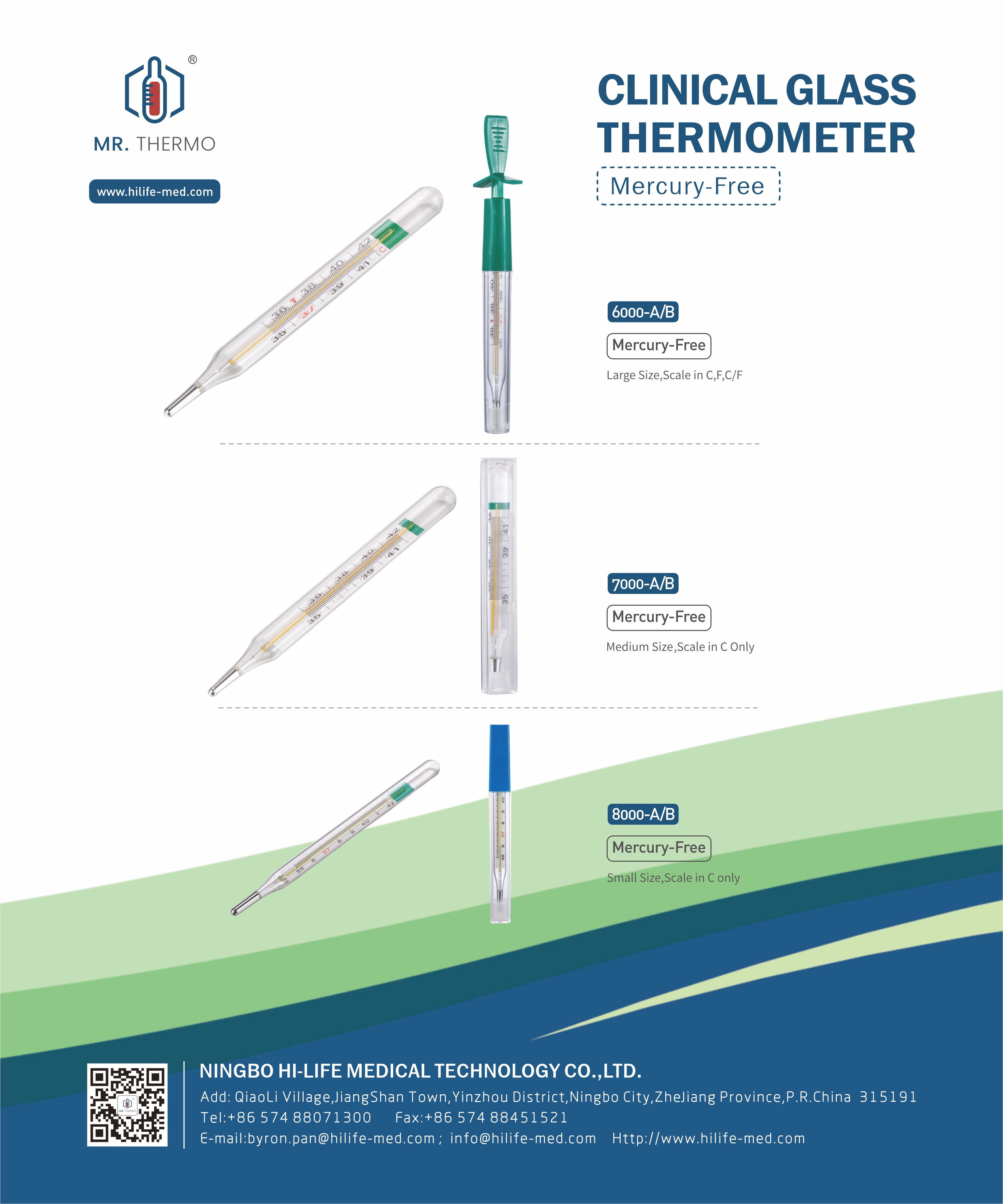
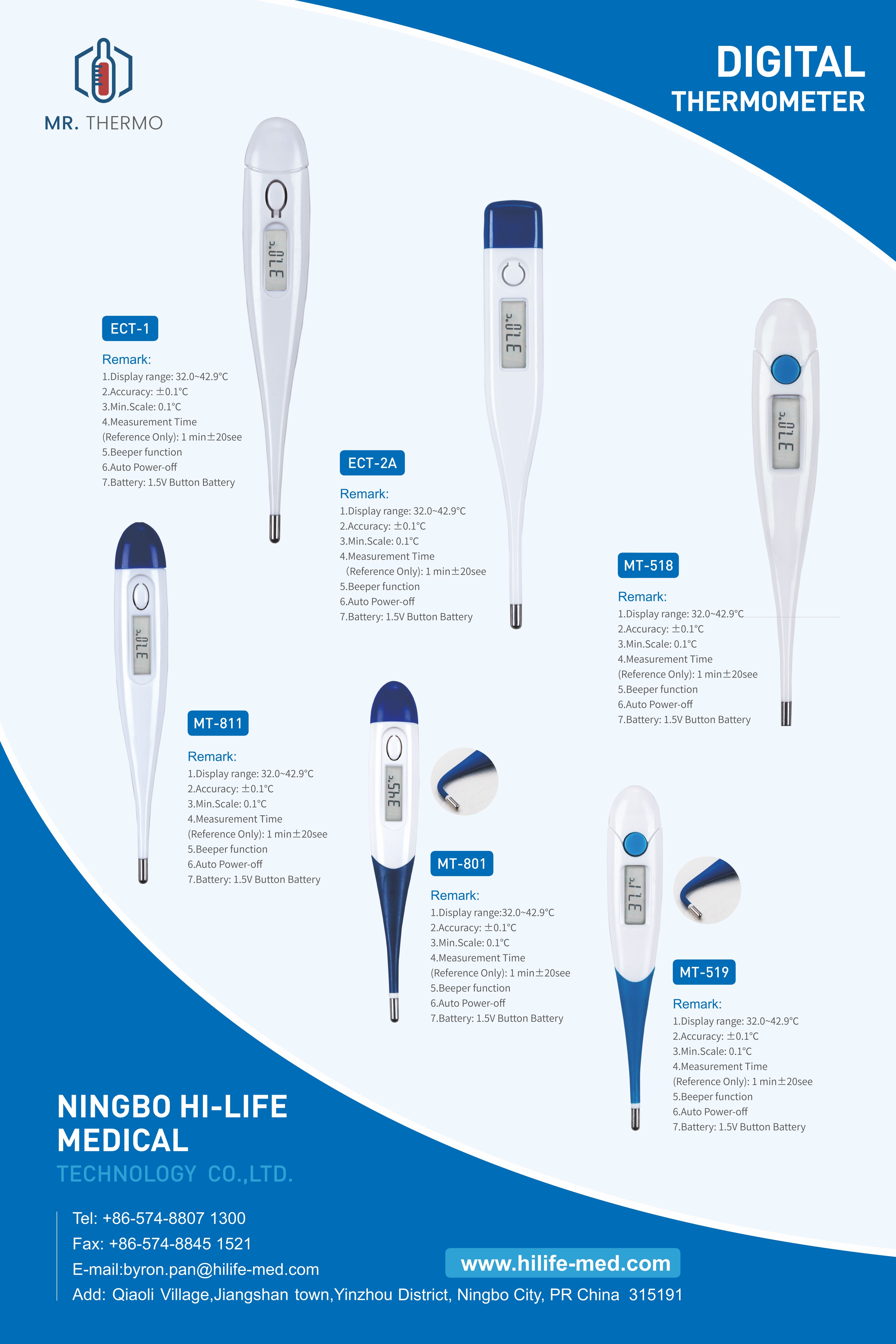
A clinical thermometer is defined by what it measures, not by how it measures. The Hi-life range contains two mercury-free families under that single heading: a mercury-free liquid-in-glass thermometer (models 6000-A and 7000-A), in which a non-toxic gallium-indium-tin alloy expands inside a borosilicate glass tube, and an electronic thermometer (models MT-518, MT-519, MT-811, MT-801 and ECT-1), which takes a reading through a stainless-steel probe and displays the value digitally.
Because both are catalogued as clinical thermometers with the same ±0.1 ℃ declared accuracy, buyers repeatedly run into four frictions:
- Catalogue compression. Price lists, tender documents and marketplace listings reduce both to a single line item, so specifications get compared as though accuracy were the only variable.
- Different failure modes. A glass tube can break; an electronic unit can stop working when the button battery is exhausted or when moisture reaches the electronics. The after-sales conversation is therefore not identical for the two products.
- Different regulatory descriptions. Under EU MDR (Regulation (EU) 2017/745), clinical thermometers are generally classified as Class IIa or Class Im depending on measurement technology and metrological function, and that classification determines the conformity assessment route behind the CE marking.
- Different user rituals. One product is read manually against a printed scale and needs no preparation. The other is switched on, returns a stated 45-second reading, displays a value and can sound a fever alarm.
None of these frictions is resolved by unit price alone. They are resolved by matching the format to the market — the exercise the rest of this article sets out.
Industry Background: Mercury-Free Is the Default, but Not a Single Product
Mercury-free technology is no longer a niche position. The global thermometer market is projected to grow from USD 2.2 billion in 2026 to USD 3.0 billion by 2030, and within that market the mercury-free thermometers segment led in 2023 with a 69.1% revenue share, according to Grand View Research (Thermometer Market Size, Share, Trends Report, 2024–2030). Mercury-free, however, describes a chemistry decision rather than a measurement mechanism: it covers liquid-in-glass, electronic contact and infrared formats alike.
Trade data shows how large the non-liquid-filled side of the category has become. Global trade of thermometers under HS code 902519 reached USD 4.93 billion in 2024, a 4.28% increase on the USD 4.73 billion recorded in 2023, according to the Observatory of Economic Complexity (OEC). The OEC definition for HS 902519 covers thermometers except liquid filled, which means liquid-in-glass models sit outside that basket and are classified under a different tariff line — a detail importers should confirm with their customs broker before committing to a landed-cost model.
Two documents frame the buyer's due diligence on the technical side. ISO 80601-2-56:2017 is the international standard covering the basic safety and essential performance of clinical thermometers for body temperature measurement. In the European Union, Regulation (EU) 2017/745 (MDR) classifies clinical thermometers generally as Class IIa or Class Im depending on measurement technology and metrological function; published guidance cites clinical electronic thermometers as Class IIa under Rule 10 and clinical colour-change thermometers as Class Im under Rule 1. Both classifications are legitimate — they simply require different documentation packages from the manufacturer.
What Each Option Actually Is
Mercury-Free Liquid-in-Glass Thermometer (6000-A, 7000-A)
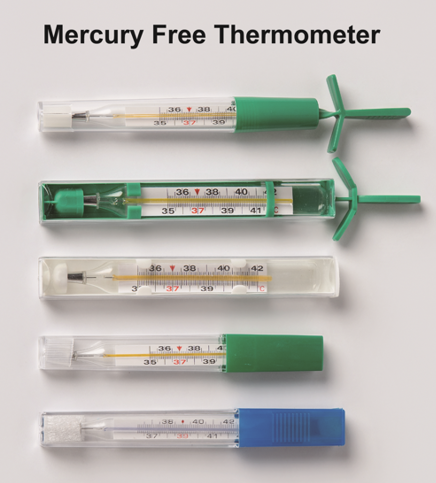
This product is a mercury-free liquid-in-glass thermometer intended for medical and homecare scenarios. It has a measuring range of 35 ℃ to 42 ℃, a scale division of 0.1 ℃ and a measurement accuracy of ±0.1 ℃. It features a maximum temperature indicator and a shock-resistant glass tube. The primary material is borosilicate glass, and the tube is filled with a non-toxic gallium-indium-tin alloy. The product is reusable and requires no battery; it is mercury-free and eco-friendly, and it is supplied with individual packaging for pharmacy and retail settings.
Electronic Thermometer (MT-518, MT-519, MT-811, MT-801, ECT-1)
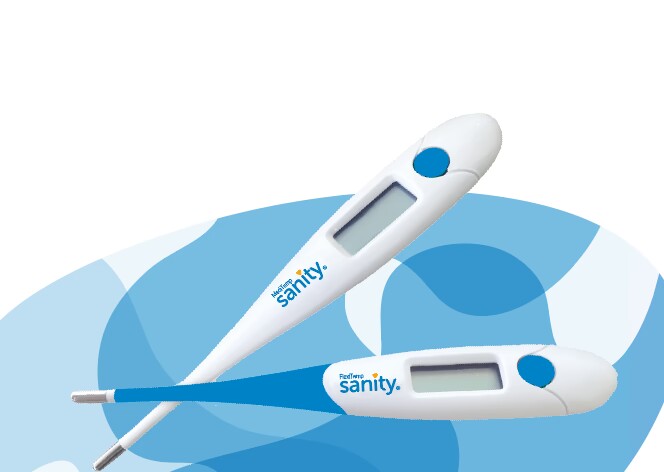
This product is an electronic thermometer classified as a clinical thermometer and intended for the medical device and homecare products industry. Its measuring range is 32.0 ℃ to 43.9 ℃, its measurement accuracy is ±0.1 ℃, and its stated response time is 45 seconds. It has a fever alarm, an auto power-off function and a soft optional tip. Power comes from a 1.5V button battery, the protection level is IP22, and the operating temperature range is 10 ℃ to 40 ℃. It is made of ABS plastic with a stainless-steel probe, and it is listed as CE compliant, RoHS, REACH and PPWR.
The Five Decision Factors That Separate the Two Formats
1. Accuracy and Measuring Range
Accuracy is the one criterion on which the two formats do not compete: both are specified at ±0.1 ℃. Range is where they diverge. The mercury-free glass thermometer is specified from 35 ℃ to 42 ℃ with a 0.1 ℃ scale division, while the electronic thermometer is specified from 32.0 ℃ to 43.9 ℃. The electronic range extends below and above the glass range, which matters to buyers whose end users may need to record readings at either extreme; the glass range concentrates on the body-temperature window that covers routine fever measurement.
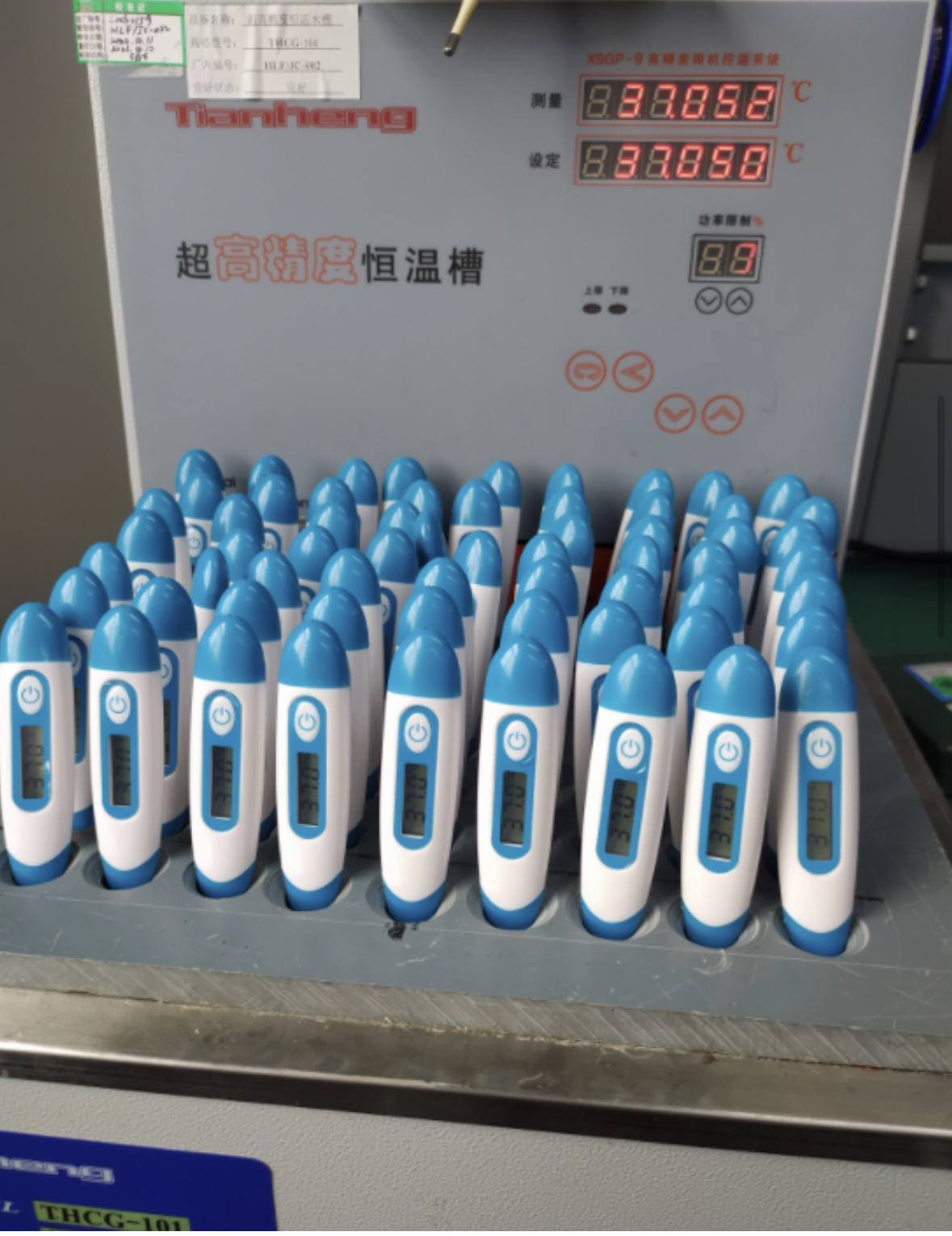
Verification is the buyer's second question. Hi-life operates well-equipped in-house testing laboratories and applies full-process quality monitoring from raw-material incoming inspection to finished-product delivery, so accuracy claims should be requested together with the corresponding test documentation rather than assumed from a catalogue figure.
2. Durability and Construction
The glass format is built around a shock-resistant glass tube in borosilicate glass, with a maximum temperature indicator. Its fragility is addressed through materials and packaging rather than through electronics. The electronic format uses an ABS plastic housing and a stainless-steel probe with an IP22 protection rating. In practice the two produce different returns profiles: glass failures tend to be physical breakage, while electronic failures tend to be battery depletion or moisture ingress. Importers should align warranty terms and spare-part planning with the failure mode they are actually exposed to.
3. Battery Reliance and Maintenance
The mercury-free glass thermometer requires no battery and can be stored between uses without any power consideration; the electronic thermometer runs on a 1.5V button battery and operates within an ambient range of 10 ℃ to 40 ℃. That difference drives three practical consequences: battery documentation and transport requirements in regulated or cross-border channels; replacement-battery expectations in the retail market; and the fact that an electronic unit's usability is partly a function of its power source, while a glass unit's usability is not. Buyers entering markets with strict battery labelling rules should confirm the documentation position early rather than at the port.
4. Ease of Reading and User Experience
Reading is manual on the glass model: the user aligns the alloy column against the printed 0.1 ℃ scale. The electronic model displays the value digitally, includes a fever alarm and an auto power-off function, and offers a soft optional tip, which makes it largely self-explanatory for household users. The trade-off is preparation. The electronic model's usefulness depends on a working battery and the stated 45-second response time, while the glass model has no start-up requirement and no display to interpret. Where consumers are already accustomed to digital readouts, the electronic format usually needs less explanation at the shelf; where price sensitivity and zero-maintenance positioning dominate, the glass format is easier to present.
5. Compliance Route and Market Fit
Compliance is where an apparently simple choice becomes a sourcing decision. Under EU MDR (2017/745), clinical thermometers generally fall into Class IIa or Class Im depending on measurement technology and metrological function, so the two formats can require different technical files and conformity routes. ISO 80601-2-56:2017 sets the basic safety and essential performance expectations for clinical thermometers used to measure body temperature, and ISO 13485 defines the quality management system behind manufacturing. All Hi-life products hold EU CE (MDR) certification, and the company passed the BSCI audit in 2025. The company also serves as the Secretariat Unit of the Body Temperature Measurement Professional Committee under the China Association for Medical Devices Industry (CAMDI) and has participated in the revision and compilation of the national standard GB1588-2024.
Side-by-Side Comparison: Mercury-Free Glass vs. Electronic
The table below compares only the declared specifications of the two Hi-life product families. No figure in it is a market claim about other manufacturers, and no rating or ranking is implied.
| Decision factor | Mercury-free liquid-in-glass thermometer | Electronic thermometer |
|---|---|---|
| Product category | Mercury-free liquid-in-glass thermometer (clinical thermometer) | Electronic thermometer (clinical thermometer) |
| Model designations | 6000-A, 7000-A | MT-518, MT-519, MT-811, MT-801, ECT-1 |
| Measuring range | 35 ℃ – 42 ℃ | 32.0 ℃ – 43.9 ℃ |
| Scale / display | 0.1 ℃ scale division, manual reading | Digital display with fever (over-temperature) alarm |
| Measurement accuracy | ±0.1 ℃ | ±0.1 ℃ |
| Response time | Not stated in the product data; read manually | 45 seconds (stated) |
| Power supply | None required | 1.5V button battery |
| Materials and construction | Borosilicate glass tube, non-toxic gallium-indium-tin alloy fill, shock-resistant glass tube, maximum temperature indicator | ABS plastic housing, stainless-steel probe, IP22 protection rating |
| Operating conditions | Indoor use at normal room temperature | Operating temperature 10 ℃ – 40 ℃ |
| Additional functions | Maximum temperature indicator; reusable; no battery required | Fever alarm, auto power-off, soft optional tip, portable |
| Typical application | Clinical and home temperature measurement; pharmacy and retail counters; individual packaging | Home medical care; clinical temperature-measurement projects; battery-powered automatic measurement |
| Declared compliance | Covered by the company statement that all products hold EU CE (MDR) certification | Listed as CE compliant, RoHS, REACH and PPWR |
Step-by-Step: Aligning the Format with Your Target Market
- Define the end-user setting first. The glass model's application data describes indoor use at normal room temperature, manual reading, reusable operation and no supporting equipment required, with individual packaging for pharmacy-style retail. The electronic model's application data describes home medical care and clinical temperature-measurement projects, battery-powered automatic measurement, and a requirement profile built around high precision, portability and an over-temperature alarm. Decide which of those two settings your market actually is before comparing prices.
- Confirm the regulatory route for the destination market. Establish whether the market follows EU MDR, identify the classification that applies to the measurement technology you intend to import (generally Class IIa or Class Im), and request the manufacturer's ISO 13485 certificate and CE (MDR) documentation. Ask for the documents before the quotation, not after.
- Match the measuring range to the use case. If routine body-temperature measurement inside the 35 ℃ to 42 ℃ window is the whole requirement, both formats qualify on range. If the end user may record values below 35 ℃ or above 42 ℃, only the electronic model's declared 32.0 ℃ to 43.9 ℃ range covers it.
- Decide how much maintenance the market will tolerate. A battery-free product removes replacement and disposal questions but is read manually. A battery-powered product removes reading effort but introduces a consumable. This is a merchandising and after-sales decision rather than a technical one.
- Check the packaging model against the channel. The glass format is associated with individual packaging in retail and pharmacy settings; the electronic format is associated with retail display packaging. Shelf-ready display, individual blister or bulk packaging should be confirmed as part of the specification, together with private-label and OEM/ODM customization.
- Validate with samples before the purchase order. Request samples of both formats, verify the declared ±0.1 ℃ accuracy and the measuring ranges, and test the electronic unit inside its stated 10 ℃ to 40 ℃ operating range. Record the results — that file becomes your internal justification for the final choice.
- Confirm production scheduling and capacity line by line. Hi-life manufactures in standardized production workshops with full-process quality monitoring and an annual production capacity of 3,500,000 units, supported by an in-house R&D team of eight engineers. Because the two formats draw on different component chains — glass tube forming and alloy filling on one side, electronics and battery supply on the other — scheduling should be confirmed per line rather than as a single blanket lead time.
Use Cases: Where Each Format Fits
Where the mercury-free glass thermometer fits
- Pharmacy and retail counters that want a battery-free, reusable clinical thermometer with no consumable to stock.
- Markets where mercury-free, non-toxic positioning is a primary purchase driver and the product is presented in individual packaging.
- Households that prefer a manual-reading instrument with a maximum temperature indicator and no display to manage.
- Buyers who need a product that can be stored between seasons with no power consideration whatsoever.
Where the electronic thermometer fits
- Home medical care settings that value a fast, easily read result and an over-temperature (fever) alarm.
- Clinical temperature-measurement projects where the wider 32.0 ℃ to 43.9 ℃ range is required.
- Retail channels using display-box merchandising, private-label programmes or OEM/ODM customization.
- Portable and travel-oriented use, where a compact battery-powered unit, auto power-off and a soft optional tip are relevant.
For buyers whose portfolio covers more than these two lines, the wider Hi-life range also includes eco-friendly glass thermometers, infrared ear and forehead thermometers, industrial infrared thermometers and water thermometers.
Compliance Notes for Importers
Four documents to request per format, not per manufacturer:
- EU MDR classification position. Clinical thermometers are generally classified as Class IIa or Class Im depending on measurement technology and metrological function; the classification determines the conformity route behind the CE marking.
- ISO 80601-2-56:2017 — the international standard for basic safety and essential performance of clinical thermometers for body temperature measurement.
- Quality system evidence. ISO 13485 adherence, EU CE (MDR) certification for all products, and the BSCI audit passed in 2025.
- Tariff classification. HS 902519 as defined by the OEC covers thermometers except liquid filled, so liquid-in-glass models fall under a different heading. Confirm the correct line for your product with a customs broker.
Frequently Asked Questions
Do mercury-free glass and electronic clinical thermometers follow the same EU regulatory classification?
Not necessarily. Under EU MDR (Regulation (EU) 2017/745), clinical thermometers are generally classified as Class IIa or Class Im depending on the measurement technology and metrological function, and published guidance cites clinical electronic thermometers as Class IIa under Rule 10 while clinical colour-change thermometers are cited as Class Im under Rule 1. The classification determines which conformity assessment route supports the CE marking, so buyers should request the applicable documentation for the specific technology they intend to import. ISO 80601-2-56:2017 is the international standard covering the basic safety and essential performance of clinical thermometers for body temperature measurement. All Hi-life products hold EU CE (MDR) certification, and the company operates an ISO 13485 quality management system.
Can a single manufacturer supply both a mercury-free glass line and an electronic line?
Yes. Ningbo Hi-life Medical Technology Co., Ltd. manufactures both as core products: mercury-free liquid-in-glass thermometers in models 6000-A and 7000-A, and electronic thermometers in models MT-518, MT-519, MT-811, MT-801 and ECT-1. The company operates a 9,700 m² facility with approximately 55 staff, an in-house R&D team of 8 engineers and an annual production capacity of 3,500,000 units. It exports to more than 50 countries and regions, with the EU and the United States as major markets and export business accounting for 70% of total sales. Sourcing both formats from one manufacturer keeps packaging, labelling and documentation under a single quality system.
Which format costs less per unit?
The supplied product data does not include pricing, and the two formats are built from different components, so a like-for-like comparison depends entirely on the configuration quoted. The mercury-free glass thermometer is built around a borosilicate glass tube, a non-toxic gallium-indium-tin alloy fill, a 0.1 ℃ printed scale, a maximum temperature indicator, a shock-resistant glass tube and individual packaging. The electronic thermometer is built around an ABS housing, a stainless-steel probe, electronics with a fever alarm and auto power-off, a soft optional tip and a 1.5V button battery, plus RoHS, REACH and PPWR compliance. Buyers should request quotations for both formats against an identical specification brief — accuracy, range, packaging and documentation — instead of comparing a single unit price.
How can buyers verify the accuracy of each format before ordering?
Both formats are declared at ±0.1 ℃ measurement accuracy. The glass model carries a 0.1 ℃ scale division and a 35 ℃ to 42 ℃ range; the electronic model adds a stated 45-second response time and a 32.0 ℃ to 43.9 ℃ range. The practical verification path is to request samples of both, test the electronic unit inside its stated 10 ℃ to 40 ℃ operating range, and compare readings against the declared specification. Hi-life supports this with well-equipped in-house testing laboratories and full-process quality monitoring from raw-material incoming inspection to finished-product delivery, and sample requests can be raised directly with the sales contact.
What supply and lead-time factors should importers plan for?
The two formats depend on different component chains. The mercury-free glass line depends on borosilicate glass tubes and gallium-indium-tin alloy filling, while the electronic line depends on ABS housings, stainless-steel probes, electronics and 1.5V button batteries. Hi-life produces in standardized workshops with an annual capacity of 3,500,000 units and monitors quality across the full production process, but because the inputs differ, delivery scheduling is best confirmed per line and per configuration rather than assumed to be identical. Buyers planning a launch should confirm the schedule for each format separately and align it with packaging, private-label and documentation timelines. To start a sample or quotation request for either format, contact byron.pan@hilife-med.com or review the 2025 catalogue.
Conclusion: A Decision You Can Document
The comparison resolves into four points. Both formats are specified at ±0.1 ℃ accuracy. The mercury-free glass thermometer (6000-A, 7000-A) covers 35 ℃ to 42 ℃ with a 0.1 ℃ scale division, needs no battery, uses a shock-resistant borosilicate tube with a maximum temperature indicator, and is read manually. The electronic thermometer (MT-518, MT-519, MT-811, MT-801, ECT-1) covers 32.0 ℃ to 43.9 ℃, returns a stated reading in 45 seconds, is rated IP22, runs on a 1.5V button battery, and adds a fever alarm and auto power-off. Neither is universally better; each is a different answer to a market's expectations about maintenance, measuring range and reading.
Buyers who work through the seven steps above — end-user setting, regulatory route, measuring range, maintenance tolerance, packaging model, sample validation and production scheduling — finish with a documented rationale rather than a price-driven guess. That documentation is also what makes the supplier conversation faster, because the specification questions have already been answered.
Next Step: Compare Both Formats on Paper
Ningbo Hi-life Medical Technology Co., Ltd. (Mr.Thermo) supplies mercury-free liquid-in-glass thermometers and electronic thermometers, alongside eco-friendly glass, infrared ear and forehead, industrial infrared and water thermometers, under OEM and ODM programmes. Request samples or a specification-matched quotation for the formats relevant to your market.
Email: byron.pan@hilife-med.com | Tel / WhatsApp: +86 139-5788-8585
Address: 371 Zhenshi Road, Jiangshan Town, Yinzhou District, Ningbo City, Zhejiang Province, 315191, P.R. China
Website: www.hilife-med.com
Download the 2025 catalogue: Hi-life Medical Catalogue 2025 (PDF)
Have Questions or Need More Details?
Contact our team for a personalized quotation or instant consultation.
Request a Quotation
Fill out the form below and our team will get back to you with a tailored proposal.
WhatsApp Direct Chat
Prefer to chat in real-time? Message us on WhatsApp for instant assistance & quick answers.
- Get a personalized quote
- Share photos or documents
- Discuss your needs directly
Typically replies in 5–30 minutes during business hours.