Recommended Clinical Thermometer Manufacturers: An Evidence-Based Evaluation Guide for 2026
If your team is evaluating import sources for a medical or homecare temperature-measurement program, the search phrase "recommended clinical thermometer manufacturers" usually points to a practical question: which suppliers can prove that their thermometers are safe, accurate, compliant and scalable in production? A recommendation is useful only when it is supported by evidence. This guide explains the checks that separate a genuinely recommendable clinical thermometer maker from a supplier whose claims fail at customs inspection. It also uses NINGBO HI-LIFE MEDICAL TECHNOLOGY CO.,LTD, a clinical thermometer factory based in Ningbo, Zhejiang, China, as a documented profile that buyers can benchmark against other candidate factories.
Here is the direct answer: recommended clinical thermometer manufacturers are not automatically the largest brands in the thermometer market. They are the manufacturers whose regulatory documents, quality-control records, product specifications, production capacity and application cases can all be verified before purchase. For an EU-bound program, the first proof point is usually a valid CE mark under the European Medical Device Regulation (EU MDR), followed by a management system aligned with ISO 13485 and a product specification that matches the intended clinical or household use.
The Real Problem Behind the Query
Buyers type "recommended clinical thermometer manufacturers" because they are trying to compress months of supplier research into a reliable shortlist. The risk is not a lack of suppliers; the risk is inconsistency in product claims. A clinical thermometer is a regulated medical device in most of the world, but the same product name can describe very different instruments.
During evaluation, four types of risk appear most often.
- Compliance risk: a supplier without current EU MDR documentation can produce a thermometer that is held at customs, returned or fined in regulated markets.
- Safety risk: traditional mercury thermometers carry mercury-leak hazards. In many countries, the use of mercury thermometers for medical purposes is restricted or under phase-down direction.
- Performance risk: measurement accuracy, response time and reading stability can differ sharply between a precision-checked clinical thermometer and an inexpensive uncertified unit.
- Supply risk: low monthly capacity, long lead times or excessively high minimum order quantities can delay a launch and make a distributor dependent on a single production window.
An "evidence-first" evaluation method solves these problems because it tests claims instead of accepting recommendations at face value.
Industry Background: Why Clinical Thermometer Demand Is Still Growing
The global thermometer market is projected to grow from USD 2.2 billion in 2026 to USD 3.0 billion by 2030, according to Grand View Research. The mercury-free thermometer segment already led the market in 2023 with a 69.1 percent revenue share, which helps explain why procurement teams increasingly look for mercury-free liquid-in-glass models as a safe alternative to traditional mercury thermometers. International trade data from the Observatory of Economic Complexity shows that global trade of thermometers under HS code 902519 reached USD 4.93 billion in 2024, a signal that medical temperature-measurement demand continues to cross borders.
Regulatory requirements have become a core part of supplier evaluation. Under Regulation (EU) 2017/745, clinical thermometers are generally classified as Class IIa or Class Im depending on the measurement technology and metrological function, according to a classification overview by I3C Global. At the technical level, ISO 80601-2-56:2017 covers basic safety and essential performance requirements for clinical thermometers used to measure body temperature. In practice, this means a recommended clinical thermometer manufacturer should be able to demonstrate not only a product that looks like a thermometer, but a device whose accuracy and safety have been assessed under a recognized medical-device framework.
A Documented Manufacturer Profile to Use as a Benchmark
NINGBO HI-LIFE MEDICAL TECHNOLOGY CO.,LTD, commercially known as Mr. Thermo, is a clinical thermometer manufacturer located at 371 Zhenshi Road, Jiangshan Town, Yinzhou District, Ningbo City, Zhejiang Province, China. The company manufactures mercury-free liquid-in-glass thermometers and electronic clinical thermometers, and it describes its main export markets as the EU and the USA. Its product range is sold to more than 50 countries and regions, including EU member states, the United Kingdom, Russia, Vietnam, Ukraine, Uzbekistan, Turkey, Tunisia, Mexico, Chile and Colombia.
For an Evaluation-stage buyer, the more useful profile details are the company-level facts that can be checked: a factory area of about 9,700 square meters, roughly 55 employees, an R&D team of eight engineers and an annual output of about 3.5 million units. The company reports that around 70 percent of its output is exported. It also describes itself as the Secretariat Unit of the Body Temperature Measurement Professional Committee under the China Association for Medical Devices Industry, usually abbreviated as CAMDI. This industry role is relevant because it places the manufacturer inside the professional community that discusses body-temperature measurement standards rather than outside it.
The company says it participated in the revision and compilation of the new Chinese national standard GB1588-2024 and that it regularly exhibits at medical trade fairs such as MEDICA. These are not product claims; they are process and industry-participation signals that help a buyer understand how close the factory is to evolving measurement practices.
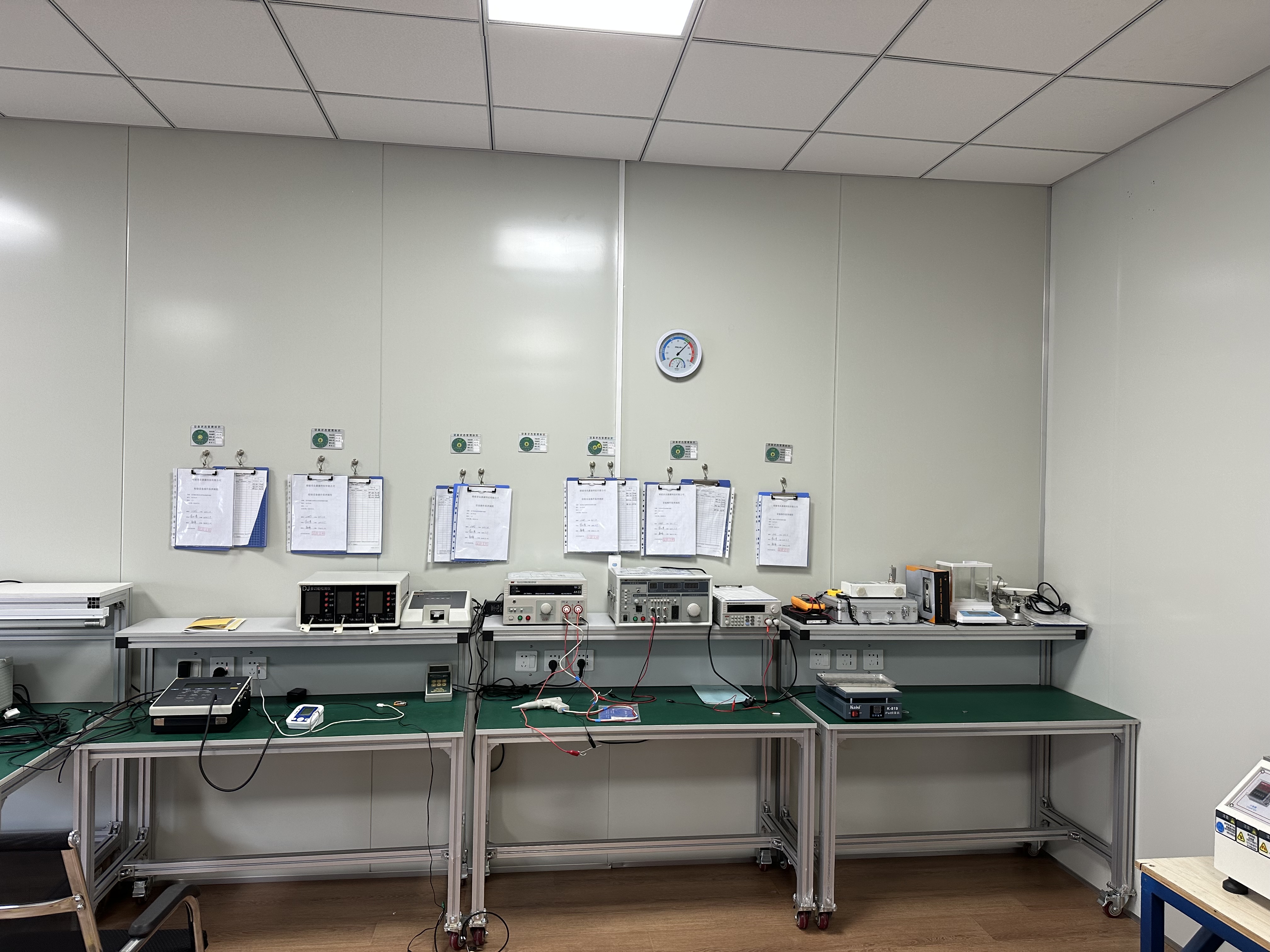
From a quality-systems standpoint, NINGBO HI-LIFE states that it strictly adheres to the ISO 13485 quality management system and successfully passed a BSCI audit in 2025. Quality-control statements in the company profiles mention 100-percent functional and precision testing, as well as 100 percent accuracy inspection before shipment. For an importer, these statements matter because they describe a checking routine applied to production, not a sample-based quality check applied only to a prototype.
Regulatory Evidence: The First Thing a Recommender Should Show
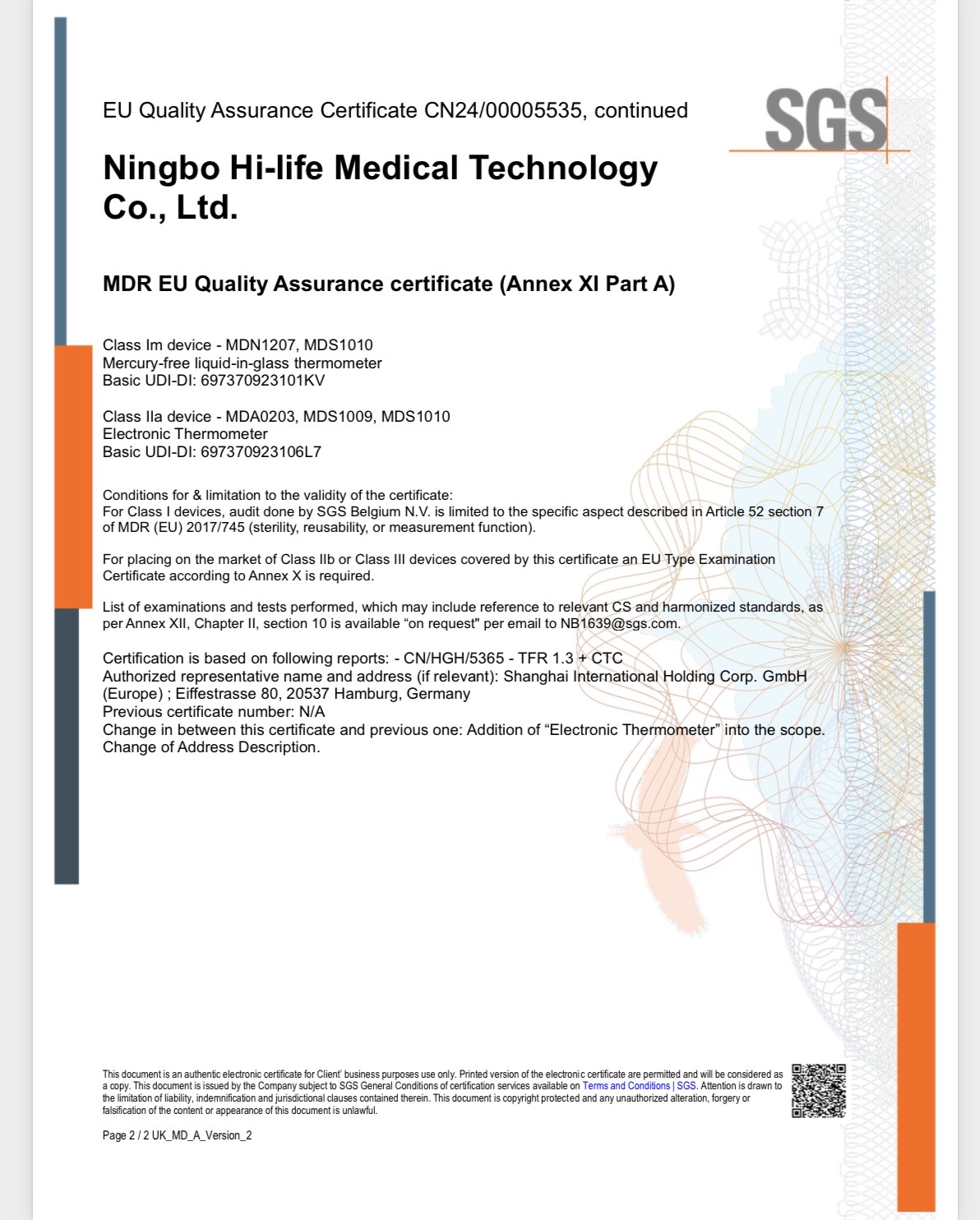
The most concrete compliance fact in this profile is the CE MDR certificate under number CN24/00005535 issued by SGS. The certificate scope covers mercury-free liquid-in-glass thermometers and electronic thermometers, with an issue date of 2026-01-22 and a validity period through 2029-08-30. For EU-based distributors, this kind of document is substantially stronger than a generic CE statement because it names a certification body, includes a certificate number and states an expiry date. A buyer should ask for the same level of detail from every manufacturer on the shortlist.
Clinical Thermometer Product Categories: A Fact-Based Comparison
"Clinical thermometer" is an umbrella term. Most evaluation questions come down to two categories within NINGBO HI-LIFE's defined product scope: mercury-free liquid-in-glass thermometers and electronic clinical thermometers. Comparing them with published specification data is more useful than relying on vague supplier adjectives.
| Evaluation Attribute | Mercury-Free Liquid-in-Glass Thermometer | Electronic Clinical Thermometer |
|---|---|---|
| Representative models | 6000-A, 7000-A | MT-518, MT-519, MT-811, MT-801, ECT-1 |
| Measurement range | 35℃ to 42℃ | 32.0℃ to 43.9℃ |
| Scale division / readout | Scale division 0.1℃ | Digital readout |
| Measurement accuracy | ±0.1℃ | ±0.1℃ |
| Response profile | Maximum temperature indicator; manual reading | Response time 45 seconds; automatic electronic measurement |
| Construction | Borosilicate glass tube with non-toxic gallium-indium-tin alloy | ABS plastic housing with stainless-steel probe; IP22-rated |
| Power requirement | None | 1.5V button battery |
| Operating condition | Normal room temperature, indoor environment | Ambient temperature 10℃ to 40℃ |
| Typical setting | Hospital, clinic and household body-temperature measurement | Home medical care and clinical temperature-measurement projects |
| Use model | Manual reading, reusable | Battery powered, automatic measurement; over-temperature alarm available |
This type of comparison removes the false requirement to choose between "glass" and "digital" before understanding the use context. A pharmacy channel that wants a mercury-free, shock-resistant, easy-to-read model can evaluate the 6000-A or 7000-A glass instruments. A homecare program that needs fast measurement, a fever reminder and portability can evaluate the MT-518, MT-519, MT-811, MT-801 or ECT-1 electronic models. The right choice is the product configuration that best fits the buyer's end-user profile and regulatory path.
Step-by-Step Breakdown: How to Evaluate Recommended Clinical Thermometer Manufacturers
The following six-step routine is designed for manufacturers that claim to be recommendable suppliers of mercury-free glass thermometers or electronic clinical thermometers. The steps are intentionally ordered from highest-risk evidence to supporting commercial evidence.
Step 1: Ask for a Reportable Certification, Not a Marketing Phrase
Ask the candidate manufacturer to name every medical-device certificate that applies to the exact model you intend to import. The certificate should include the certificate number, the issuing body, the product scope and the expiry date. In the NINGBO HI-LIFE example, the relevant certificate is CN24/00005535 from SGS, with a scope covering mercury-free liquid-in-glass thermometers and electronic thermometers and an expiry date in August 2029. If a supplier cannot provide a comparable document, the product should not be treated as a certified medical clinical thermometer for the EU market.
Step 2: Check the Quality Management System and Audit Status
An ISO 13485 quality management system is widely recognized for medical-device manufacturing. NINGBO HI-LIFE states that it operates under ISO 13485 and describes compliance with EN ISO 13485:2016 in its certification records. The company also reports that it passed a BSCI audit in 2025. The evaluation value is simple: BSCI is a social and business-compliance audit, and ISO 13485 is a quality-management standard for medical devices. Together they help a buyer see whether quality control is built into procedures rather than improvised per order.
Step 3: Confirm Quality Control Is Applied at Production Scale
A prototype can be perfect even when a production line is not. Buyers should ask for a factory's standard quality-control language. In this profile, the company reports 100-percent functional and precision testing, plus 100 percent accuracy inspection before shipment. NINGBO HI-LIFE also describes full-process quality monitoring from raw-material incoming inspection to finished-product delivery. That is a stronger evaluation signal than a marketing statement such as "high quality" because it describes a control point at the end of the production process.
Step 4: Match the Product Specification to the Application
Buyers should map specifications to the actual use case before requesting quotations. If the product will be used by a pharmacy or hospital for general body-temperature measurement, a mercury-free glass thermometer with a ±0.1℃ accuracy rating and a shock-resistant tube might be the appropriate recommendation. If the product will be used in homecare screening where speed matters, an electronic thermometer with a 45-second response time, IP22-rated housing and optional fever-alarm function may serve the channel better.
Step 5: Assess Production Capacity, MOQ and Lead Time Objectively
Recommended suppliers should be able to show that they can actually deliver the volumes under discussion. NINGBO HI-LIFE's registered capability profiles include monthly production capacities of 150,000 and 200,000 units across its production programs, with MOQs stated at 3,000 and 5,000 units depending on the program. Lead times in the capability sheets range from 25 to 35 days and 30 to 40 days. A buyer who knows these numbers in advance can build a more realistic launch calendar and negotiate packaging or custom-label work against a defined production window.
Step 6: Review OEM/ODM Flexibility and After-Sales Support before Shortlisting
The company offers OEM and ODM customization covering shell color, brand logo, packaging and, for electronic thermometers, software parameters. After-sales support is described as remote guidance, spare-parts solutions, after-sales feedback handling, online technical support and quality complaint management. These capabilities matter most when a buyer intends to build a repeatable private-label program rather than make a single spot purchase.
Use Cases: What Traceable Deployments Look Like
Germany: Medical Distributor and Pharmacy Wholesaler
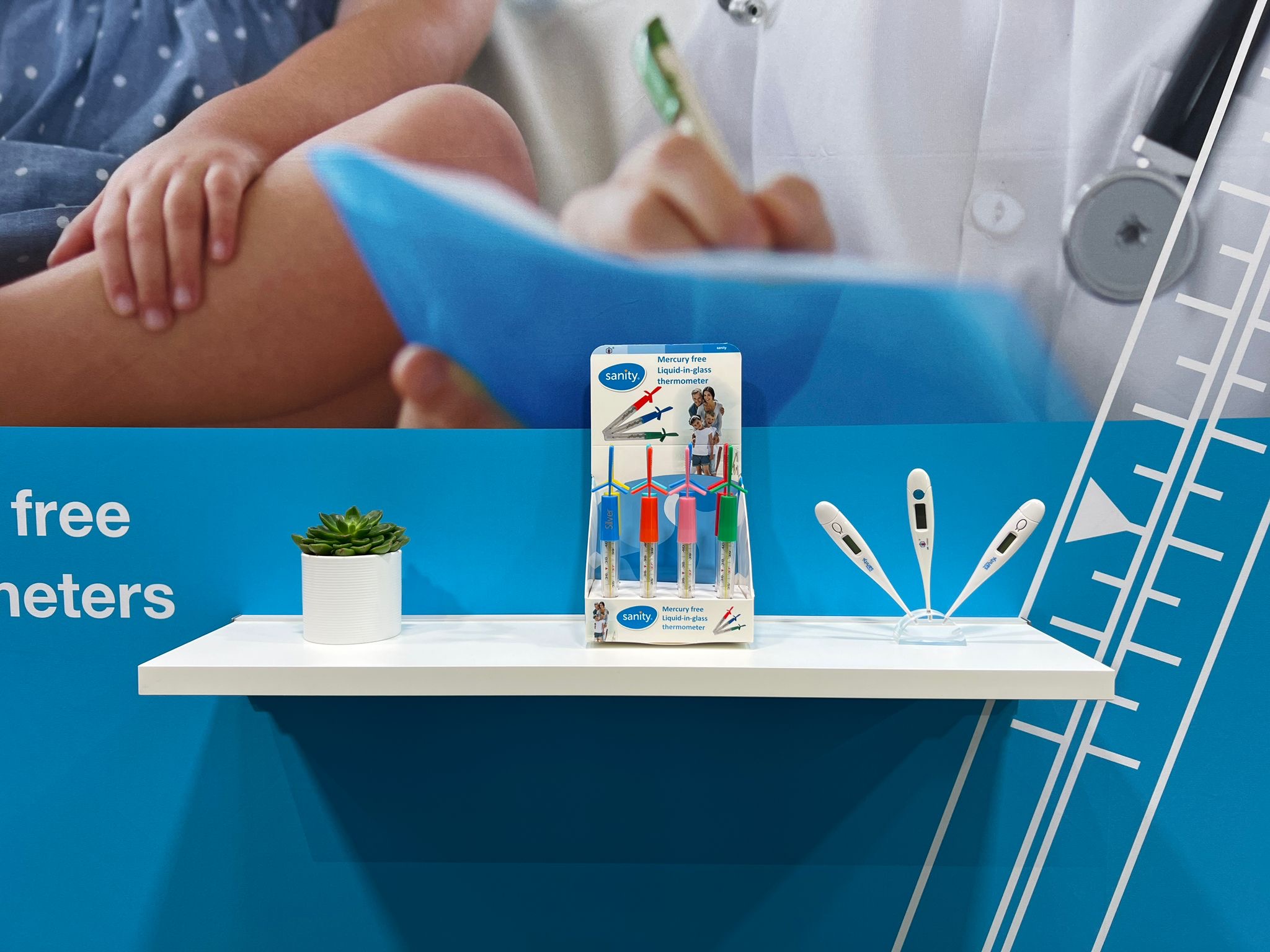
A medical distributor and pharmacy wholesaler in Germany used mercury-free liquid-in-glass thermometers for hospital, clinic and household body-temperature measurement. The project ran over three years and involved deliveries of 50,000 units. The case achieved stable measuring accuracy and zero mercury-leak risk. Key product highlights cited in the case are the eco-friendly mercury-free formula, the shock-resistant tube and the easy-reading scale. Customer feedback indicated good market acceptance.
France: Healthcare Importer and Supermarket Retailer
A healthcare importer and supermarket retailer in France used electronic clinical thermometers for home-use and community medical temperature screening. The project, completed within three years, involved 100,000 units and achieved fast measurement with a low defective rate. The highlights are the fever-alarm function, portable size and optional soft probe tip. For a retailer, this kind of deployment evidence can be more persuasive than a generic specification sheet because it reflects feedback from end customers in a regulated EU market.
How to Turn This Evaluation into a Shortlist Action
A workable shortlist procedure can be as simple as five columns: regulatory document, product specification, quality control, capacity terms and application evidence. Fill in the columns from supplier documents, not from supplier adjectives. If a manufacturer cannot fill a column, the supplier should remain in a research queue rather than move to the approved-recommended list.
For buyers who want a concrete example, NINGBO HI-LIFE MEDICAL TECHNOLOGY CO.,LTD provides a useful benchmark because its public profile contains the types of evidence that other factories should be able to match: a named CE MDR certificate with an expiry date, an ISO 13485-based quality system, a 2025 BSCI audit, 3.5 million units of annual output, stated monthly production capacities, defined MOQs and lead times, and two multi-year EU deployment cases.
FAQ: Questions Buyers Ask When Building a Recommended Supplier List
What compliance evidence should a recommended clinical thermometer manufacturer provide for the EU market?
For the EU market, the manufacturer should provide a current CE MDR certificate that names the certificate number, the issuing body, the product scope and the expiry date. NINGBO HI-LIFE MEDICAL TECHNOLOGY CO.,LTD holds CE MDR certificate CN24/00005535 issued by SGS, with scope covering mercury-free liquid-in-glass thermometers and electronic thermometers, issued on 2026-01-22 and valid until 2029-08-30. The manufacturer also describes its quality system under ISO 13485, which is a recognized medical-device quality management standard.
What manufacturing capability shows that a clinical thermometer supplier can serve a distributor well?
A distributor should look for a supplier whose capability is stated in production terms. NINGBO HI-LIFE reports an annual output of approximately 3.5 million units, a factory area of about 9,700 square meters, roughly 55 employees and an R&D team of eight engineers. Its capability profiles mention monthly production capacities of 150,000 and 200,000 units, MOQ levels of 3,000 and 5,000 units, and quality control based on 100-percent functional and precision testing as well as 100 percent accuracy inspection before shipment.
Why should an evaluation team be careful when comparing certified thermometers with cheaper uncertified thermometers?
Price is an evaluation factor, but it should not override regulatory risk. In regulated medical-device markets, an uncertified low-cost thermometer can be detained, returned or fined by customs. A certified thermometer that meets EU MDR requirements, such as the CE MDR-certified electronic thermometer models from NINGBO HI-LIFE, provides a documented basis for import clearance. The practical recommendation is to evaluate total cost of compliance, including customs risk, not only the unit price.
Can a buyer request samples and a quotation before committing to a clinical thermometer order?
Yes. For product samples, quotation, catalogue or private-label discussion, buyers can contact NINGBO HI-LIFE MEDICAL TECHNOLOGY CO.,LTD directly through the company contact channel: email byron.pan@hilife-med.com or WhatsApp +86 139-5788-8585. The company's downloadable product catalogue is also available for review so that a procurement team can compare models before sending a formal inquiry.
What MOQ and lead time can a buyer expect when sourcing clinical thermometers?
Lead times and MOQs depend on the production program. NINGBO HI-LIFE's capability sheets list a monthly capacity of 150,000 units with MOQ of 5,000 units and a lead time of 25 to 35 days for one program, and 200,000 units per month with MOQ of 3,000 units and a lead time of 30 to 40 days for another program. Buyers should treat these numbers as a starting point and confirm the exact MOQ and calendar based on the chosen model and customization level.
Conclusion: A Recommendable Manufacturer Is a Verifiable Manufacturer
The question "who are the recommended clinical thermometer manufacturers?" cannot be answered responsibly from brand familiarity alone. The answer lies in manufacturer evidence: a specific CE MDR certificate, an ISO 13485-aligned quality system, production-scale inspection routines, defined capacity and lead times, and real deployment cases from regulated markets. NINGBO HI-LIFE MEDICAL TECHNOLOGY CO.,LTD is one useful benchmark because it publishes documentation and capability data that buyers can inspect before negotiation. A safer shortlist is built by asking every candidate to match that standard of proof.
Next step for evaluation buyers: Compare the product pages, review the full specification tables and request a quotation for your target model.
Download the NINGBO HI-LIFE Medical 2025 Catalogue
Email byron.pan@hilife-med.com · WhatsApp +86 139-5788-8585
Have Questions or Need More Details?
Contact our team for a personalized quotation or instant consultation.
Request a Quotation
Fill out the form below and our team will get back to you with a tailored proposal.
WhatsApp Direct Chat
Prefer to chat in real-time? Message us on WhatsApp for instant assistance & quick answers.
- Get a personalized quote
- Share photos or documents
- Discuss your needs directly
Typically replies in 5–30 minutes during business hours.