Mercury-Free Liquid-in-Glass Thermometers: Accuracy & Calibration Guide
Mercury-Free Liquid-in-Glass Thermometers: Accuracy & Calibration Guide
A clinical thermometer is a measuring instrument before it is a product. In the mercury-free liquid-in-glass category, two specifications decide whether a device is fit for clinical or homecare use: the accuracy band — ±0.1 °C on the 6000-A and 7000-A — and the testing evidence that supports that band.
This guide is a technical deep dive into those parameters. It explains what ±0.1 °C measurement accuracy actually means on a datasheet, how a maximum temperature indicator functions, why a shock-resistant glass tube matters in medical and homecare settings, and what a battery-free measuring principle changes for the buyer. It is written for procurement teams, quality engineers, distributors and homecare brand owners working through the research and evaluation stage of clinical thermometer sourcing.
Ningbo Hi-life Medical Technology Co., Ltd. (brand name Mr.Thermo) is a Chinese manufacturer of clinical thermometers based in Jiangshan Town, Yinzhou District, Ningbo, producing mercury-free liquid-in-glass thermometers and electronic thermometers for medical device and homecare markets. The company operates an ISO 13485 quality management system, holds EU CE (MDR) certification covering its thermometer lines, and serves as the Secretariat Unit of the Body Temperature Measurement Professional Committee under the China Association for Medical Devices Industry (CAMDI). This article focuses on the technical parameters of its 6000-A and 7000-A mercury-free liquid-in-glass models.
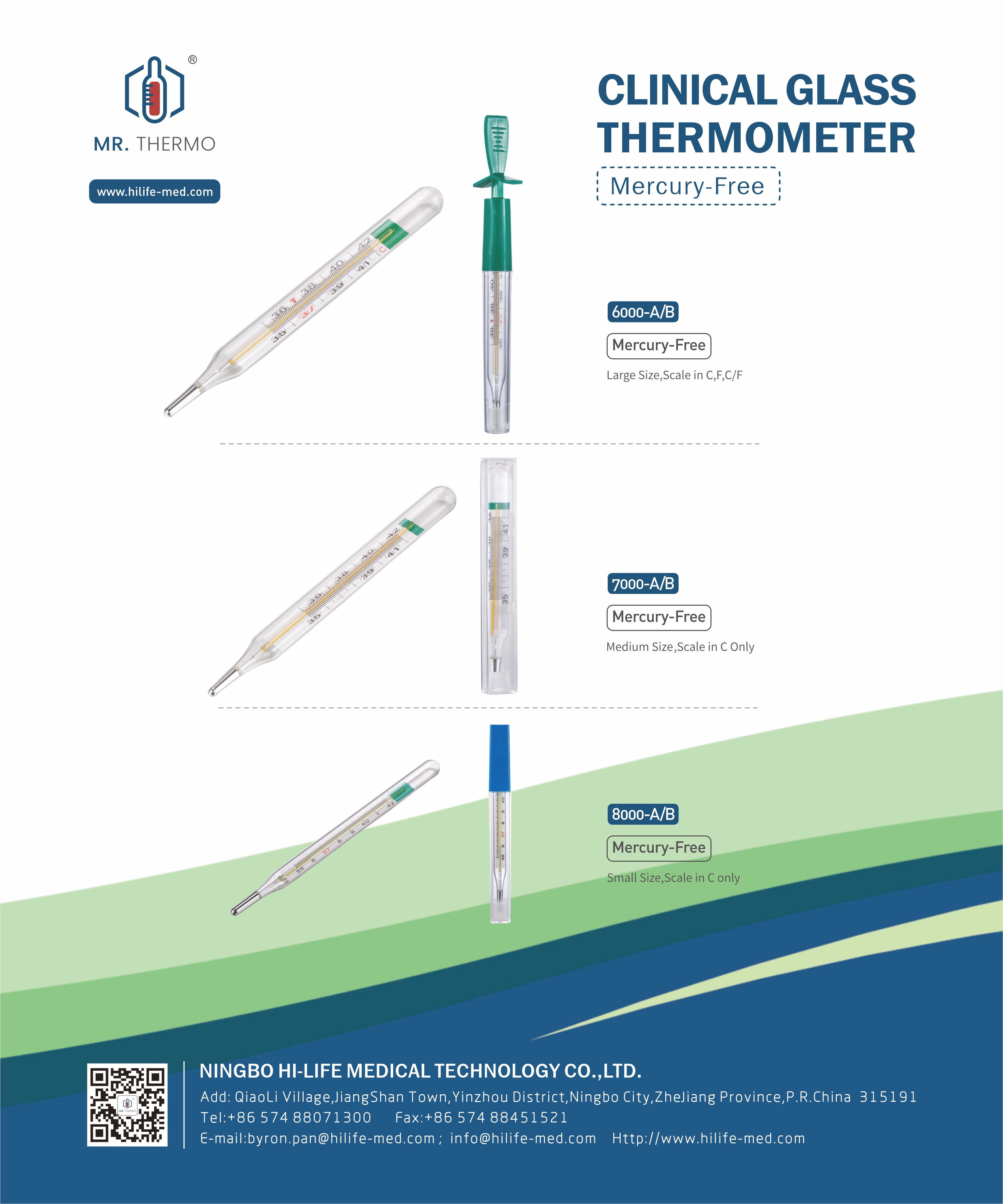
Mercury-free liquid-in-glass clinical thermometer — the 6000-A and 7000-A use borosilicate glass and a non-toxic gallium-indium-tin alloy sensing liquid.
Quick specification answer: the 6000-A and 7000-A measure 35 °C–42 °C with a 0.1 °C scale division and ±0.1 °C measurement accuracy. They use a borosilicate glass tube with a non-toxic gallium-indium-tin alloy, include a maximum temperature indicator and a shock-resistant glass tube, and require no battery.
Problem Definition: Why ±0.1 °C, "Calibrated" and "Battery-Free" Cause Confusion
Three specification misunderstandings cause most of the rework in clinical thermometer sourcing: confusing scale division with accuracy, treating "calibrated" as a label rather than a documented process, and underestimating what battery dependence changes in the field. Each one carries a cost — a rejected shipment, a technical file that fails review, or an after-sales problem that has nothing to do with the device itself.
Scale division is not accuracy
A scale division of 0.1 °C describes how finely the printed scale can be read; it is the smallest increment visible on the glass. Measurement accuracy of ±0.1 °C describes how far the indicated temperature may deviate from the true temperature. A thermometer can carry a 0.1 °C scale division and still fail a ±0.1 °C accuracy requirement, which is why the 6000-A and 7000-A list the two values separately instead of merging them into one headline number.
"Calibrated" needs a reference, a method and a record
In tender documents, "calibrated" is often used as a synonym for "accurate". Operationally it describes a process: comparison against a traceable reference at defined temperature set points, with the deviation recorded. On a liquid-in-glass thermometer there is no electronics and no adjustable firmware, so nothing inside the device can be re-programmed after production. Accuracy originates in the glass bore, the sensing liquid, the scale printing and production-level verification. That shifts the buyer's question from "does it come with a calibration certificate?" to "what is the stated accuracy specification, which product code does the certificate cover, and what happens to 100% of production?"
A battery-free principle changes the maintenance model
Removing the power source removes a set of field failures: button-cell depletion, replacement intervals, battery-related disposal documentation and transport restrictions, and a shelf-life clock that runs while goods sit in a warehouse. What it does not remove is the need for a disciplined reading procedure. A glass thermometer is read manually, with no fever alarm, no backlight and no memory. The 6000-A and 7000-A are an accuracy-and-simplicity proposition rather than a speed-and-features proposition, and that distinction should drive the use-case decision rather than the price comparison alone.
For buyers replacing legacy mercury devices, the binding constraint is regulatory rather than technical. Mercury thermometers face restrictions in most countries, and mercury-free versions are positioned as the compliant replacement path. The Hi-life 6000-A uses a non-toxic gallium-indium-tin alloy, keeps the same ±0.1 °C precision, complies with CE MDR, and completely avoids mercury leakage hazards.
Industry Background: The Regulatory and Market Context Behind Mercury-Free Glass
The mercury-free transition is no longer a niche compliance topic. According to Grand View Research's thermometer market report, the mercury-free thermometers segment led the global market in 2023 with a 69.1% revenue share. The same research projects the global thermometer market to grow from USD 2.2 billion in 2026 to USD 3.0 billion by 2030, equivalent to an 8.2% CAGR over 2024–2030.
Trade data tells a parallel story. Global trade under HS code 902519 — the customs line covering thermometers except liquid-filled types — reached USD 4.93 billion in 2024, a 4.28% increase over 2023, when trade totalled USD 4.73 billion, according to the Observatory of Economic Complexity. The scope matters for sourcing teams: liquid-filled glass thermometers sit outside that HS line, so a glass thermometer order carries a commercial and regulatory profile distinct from that of electronic or infrared devices, even when both end up in the same hospital or pharmacy channel.
On the regulatory side, clinical thermometers under EU MDR (Regulation (EU) 2017/745) are generally classified as Class IIa or Class Im, depending on measurement technology and metrological function. For basic safety and essential performance of clinical thermometers used for body temperature measurement, the relevant international reference is ISO 80601-2-56:2017.
The practical consequence for a procurement team is that "mercury-free" is a material and environmental claim, not a compliance argument on its own. A mercury-free glass thermometer still has to be supported by an ISO 13485 quality management system, by CE MDR certification where the EU market is targeted, and by documentation that links the certificate to the exact product code being imported.
Detailed Solution: The 6000-A and 7000-A Technical Profile
The 6000-A and 7000-A are mercury-free liquid-in-glass clinical thermometers manufactured by Ningbo Hi-life Medical Technology Co., Ltd. for medical device and homecare applications. Their core parameters are deliberately narrow: a 35 °C–42 °C measuring range, a 0.1 °C scale division and ±0.1 °C measurement accuracy, with a maximum temperature indicator and a shock-resistant glass tube as standard design features.
| Parameter | 6000-A / 7000-A specification |
|---|---|
| Product type | Mercury-free liquid-in-glass thermometer |
| Models | 6000-A, 7000-A |
| Measuring range | 35 °C – 42 °C |
| Scale division | 0.1 °C |
| Measurement accuracy | ±0.1 °C |
| Materials | Borosilicate glass; non-toxic gallium-indium-tin alloy sensing liquid |
| Design features | Maximum temperature indicator; shock-resistant glass tube |
| Power supply | None required |
| Reusability | Reusable |
| Intended industry | Medical device; homecare products |
What ±0.1 °C measurement accuracy means in practice
A ±0.1 °C accuracy specification means that at a true temperature of 37.0 °C, an in-tolerance unit indicates between 36.9 °C and 37.1 °C. The tolerance is declared across the 35 °C–42 °C range rather than at a single point, which is the band where febrile and normal body temperatures are read. Two consequences follow for evaluators. First, the accuracy claim only has meaning if the verification method behind it is defined. Second, the mercury-free liquid-in-glass line and the electronic line share the same ±0.1 °C accuracy class, so accuracy is not a reason to choose one measuring technology over the other — response time, power supply and handling are.
How the maximum temperature indicator functions
A maximum temperature indicator is a mechanical feature in the capillary bore above the bulb. In clinical liquid-in-glass designs, a constriction narrows the bore so that when the thermometer is removed from the measurement site and the sensing liquid begins to contract, the column breaks at the constriction. The liquid that has already risen stays in the column, so the highest temperature reached during the measurement is retained and can be read after the device is withdrawn. Resetting the indicator is done by a firm shaking motion that returns the column below the scale start point, after which the thermometer is ready for the next measurement.
The operational value is straightforward: the operator does not have to stand over the patient and watch a display, and the reading cannot be missed during an unattended measurement window. The trade-off is procedural — the retained peak column must be reset before reuse, and staff need to be trained on that step, which is a workflow consideration for multi-patient clinical settings rather than a device limitation.
The shock-resistant glass tube in medical and homecare settings
Borosilicate glass is the body material for the 6000-A and 7000-A, and the tube is specified as shock-resistant. In bedside, paediatric, pharmacy-counter and household use, drop and impact events are routine rather than exceptional, and a tube that resists those events reduces breakage loss across a distributed channel.
Breakage risk is also a materials question. Because the sensing liquid is a non-toxic gallium-indium-tin alloy rather than mercury, a broken thermometer does not create a mercury-leakage hazard; Hi-life positions the 6000-A as carrying zero mercury-leak risk and completely avoiding mercury leakage hazards while keeping ±0.1 °C precision and CE MDR compliance. Shock resistance reduces the probability of breakage, not the consequences of every possible impact, which is why individual protective packaging remains part of the specification for retail and clinical distribution.
No battery required: the technical consequences
A battery-free measuring principle is a technical property with commercial effects. There is no 1.5 V button cell to source, no battery compartment to seal, no replacement schedule for the end user, and no battery-related documentation in the shipping file. Devices can be stored and re-stored without a power source draining in the warehouse, which simplifies shelf-life management for distributors.
The same design removes features that buyers sometimes expect by default. There is no fever alarm, no auto power-off, no backlight and no memory recall, and the reading is manual. The electronic range within the same portfolio — models MT-518, MT-519, MT-811, MT-801 and ECT-1 — covers those needs with a 32.0 °C–43.9 °C range, a 45-second response time, a fever alarm, auto power-off and an optional soft tip, powered by a 1.5 V button battery. The two product families are complements, not substitutes.
Certification and compliance parameters for the EU market
For the EU, the 6000-A and 7000-A are covered by the CE MDR Certificate issued by SGS under certificate number CN24/00005535, valid for the EU/EEA market. The certificate references EN ISO 13485:2016 as the applicable standard for the mercury-free liquid-in-glass thermometer (product code 7967), was issued on 2026-01-22 and expires on 2029-08-30. The electronic thermometer (product code 7968) is covered by the same certificate number, with the applicable standard referring to report CN/HGH/5365-TFR 1.3 + CTC.
| Compliance item | Verified detail |
|---|---|
| Certification | CE MDR Certificate (mercury-free liquid-in-glass thermometer, product code 7967) |
| Certificate number | CN24/00005535 |
| Issuing authority | SGS |
| Covered market | EU / EEA |
| Applicable standard (glass line) | EN ISO 13485:2016 |
| Issue / expiry date | 2026-01-22 / 2029-08-30 |
| Additional declarations | CE compliant, RoHS compliant, REACH compliant, PPWR compliant; mercury-free and eco-friendly |
| System and industry role | ISO 13485 quality management system; BSCI audit passed in 2025; participation in the revision of national standard GB1588-2024; Secretariat Unit of the CAMDI Body Temperature Measurement Professional Committee |
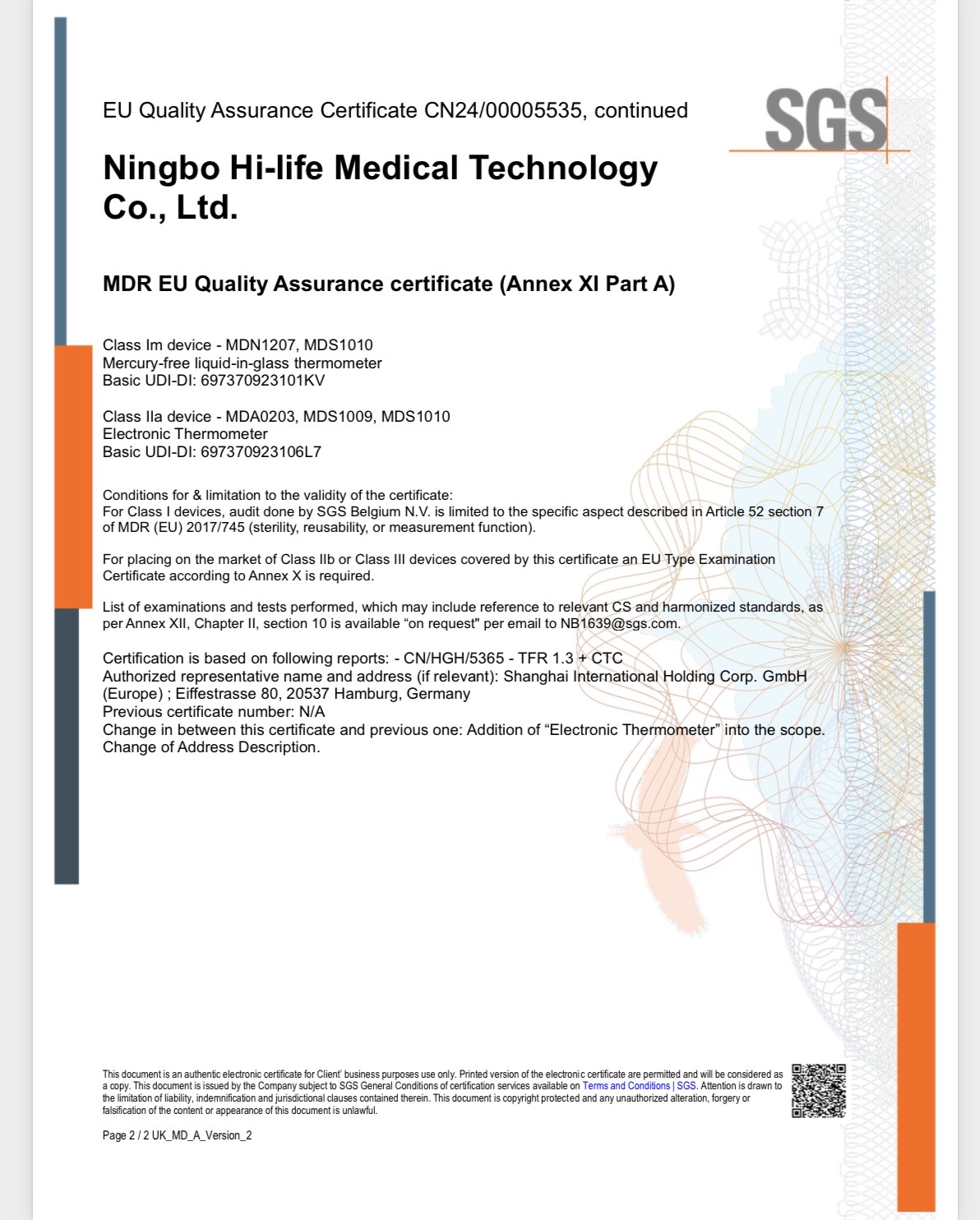
CE MDR certification issued by SGS under certificate CN24/00005535, covering the EU/EEA market and naming the mercury-free liquid-in-glass thermometer scope.
Step-by-Step Breakdown: How to Verify Accuracy and Calibration Before You Buy
Accuracy is established by a defined method and confirmed by records, not by the phrase on a datasheet. The following sequence reflects how a sourcing or quality team can verify a mercury-free liquid-in-glass thermometer against its stated ±0.1 °C specification.
- Fix the requirement before comparing suppliers. Write down the accuracy band and measuring range required for your market and use case. For the 6000-A and 7000-A, the stated values are ±0.1 °C accuracy across a 35 °C–42 °C range with a 0.1 °C scale division. Without this baseline, every datasheet looks equivalent.
- Match the certificate scope to the exact product code. Check that the CE MDR certificate number (CN24/00005535, issued by SGS) names the product code you intend to import, covers your target market (EU/EEA), and remains valid across your import window (issued 2026-01-22, expiring 2029-08-30). A certificate that does not name the product code does not support the shipment.
- Ask for the reference method behind the accuracy claim. In liquid-in-glass verification, the standard approach is a comparison calibration: the thermometer under test and a traceable reference thermometer are held at the same temperature in a controlled medium — typically a stirred liquid bath — and the deviation between the two readings is recorded at defined set points across the declared range. Ask which set points are used and how the deviation is judged against the ±0.1 °C tolerance.
- Confirm that testing is 100% rather than sampled. Hi-life states 100-percent functional and precision testing, and 100% accuracy inspection before shipment for its thermometer production, supported by in-house testing laboratories and full-process quality monitoring from raw-material incoming inspection through to finished-product delivery. For a measuring instrument, 100% inspection is the parameter that matters most.
- Verify the durability and packaging route. Confirm the shock-resistant glass tube specification in writing, along with the individual packaging format for your channel. The mercury-free glass thermometer scenario is defined for pharmacy, clinical and home use with no additional supporting equipment required.
- Check the reading and reset procedure against your environment. The mercury-free glass thermometer is specified for normal room temperature and indoor use, is reusable, and is read manually with a maximum temperature indicator that must be reset between measurements. If your setting requires a fast triage reading or an audible alarm, plan an electronic model in parallel.
- Confirm the commercial envelope before tooling or packaging development. Documented customization capability includes MOQ from 5,000 units with a 25–35 day lead time and 150,000 units monthly capacity for a private-label profile (logo printing, packaging, color and scale customization), and MOQ from 3,000 units with a 30–40 day lead time and 200,000 units monthly capacity for an OEM/ODM profile (shell color, brand logo, packaging and software parameter customization).
- Plan destination-side incoming inspection. Define the acceptance check you will run on arrival, and use long-run field evidence as a reference point: a German medical distributor and pharmacy wholesaler has run a three-year program of 50,000 units for hospital, clinic and household body temperature measurement, reporting stable measuring accuracy and zero mercury-leak risk.
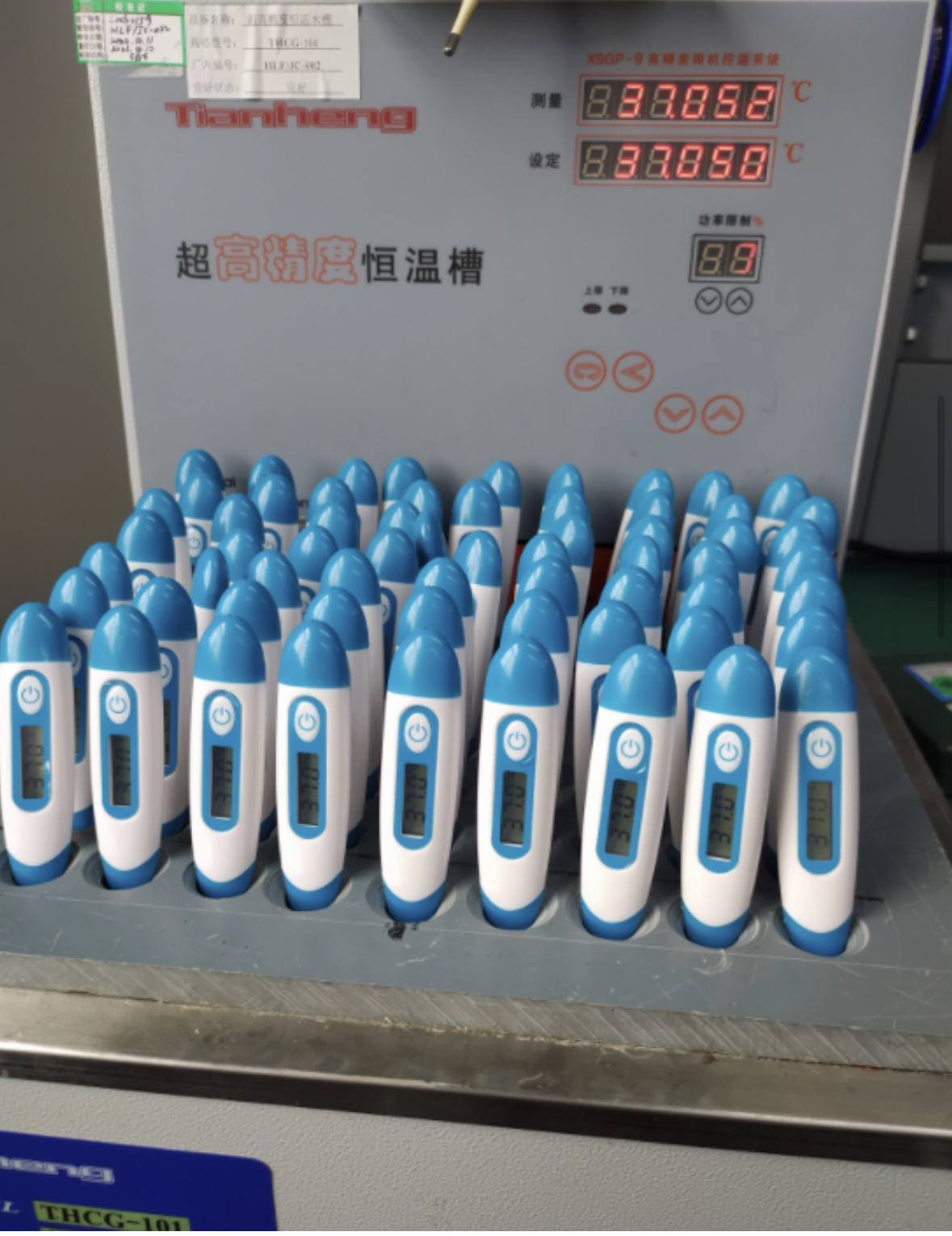
Comparison calibration in a controlled liquid bath: the thermometer under test and a traceable reference are held at the same temperature and the deviation recorded against the ±0.1 °C tolerance.
Use Cases: Where Battery-Free Glass Thermometers Fit Best
The 6000-A and 7000-A are specified for medical device and homecare applications where accuracy, hygiene and zero power dependency outweigh the need for speed and alarms.
- Hospital, clinic and household measurement. The defining application is clinical and home body temperature measurement under normal room temperature and indoor conditions, in medical and healthcare settings as well as pharmacy stores.
- Pharmacy and retail counter programmes. Because the device requires no battery and no supporting equipment, it suits counter sales and pharmacy distribution where the buyer expects a reusable instrument with individual packaging and no consumables.
- Homecare and low-infrastructure settings. Where power is intermittent or battery replacement is inconvenient, a battery-free thermometer with a retained maximum reading is easier to operate consistently than a powered device.
- Distributor programmes in regulated markets. A three-year German programme supplying 50,000 units to hospitals, clinics and households reported stable measuring accuracy, zero mercury-leak risk and positive market feedback, with the shock-resistant tube and easy-reading scale identified as the practical strengths.
- Home-use and community screening portfolios. Where a screening programme needs faster reading and a fever reminder, the parallel electronic programme illustrates the alternative: a French healthcare importer and supermarket retailer has run 100,000 units over three years for home-use and community medical temperature screening, meeting EU MDR requirements with fever alarm, portable size and an optional soft probe tip.
Where the requirement is a rapid screening reading in a queue, an audible alarm for a caregiver, or automatic data capture, the mercury-free liquid-in-glass format is the wrong instrument and the electronic range is the correct choice. Accuracy alone will not decide it.
Comparison Table: Mercury-Free Liquid-in-Glass vs Electronic Clinical Thermometers
The two thermometer families produced by Ningbo Hi-life Medical Technology Co., Ltd. share the same ±0.1 °C accuracy claim but differ on every other operating parameter. The comparison below uses only published specification values.
| Parameter | Mercury-free liquid-in-glass (6000-A, 7000-A) | Electronic (MT-518, MT-519, MT-811, MT-801, ECT-1) |
|---|---|---|
| Measuring range | 35 °C – 42 °C | 32.0 °C – 43.9 °C |
| Measurement accuracy | ±0.1 °C | ±0.1 °C |
| Resolution / division | 0.1 °C scale division | Digital display |
| Reading behaviour | Maximum temperature indicator retains the peak reading; manual readout | 45-second response time; digital readout |
| Power supply | None required | 1.5 V button battery |
| Materials | Borosilicate glass; non-toxic gallium-indium-tin alloy | ABS plastic; stainless-steel probe |
| Ingress protection | Not specified | IP22 |
| Key functions | Shock-resistant glass tube; mercury-free and eco-friendly; reusable | Fever alarm; auto power-off; optional soft tip; portable |
| Operating temperature | Normal room temperature, indoor environment | 10 °C – 40 °C |
| CE MDR status | CE MDR certificate CN24/00005535 (SGS), EU/EEA; EN ISO 13485:2016 referenced | CE MDR certificate CN24/00005535 (SGS), EU/EEA; report CN/HGH/5365-TFR 1.3 + CTC referenced |
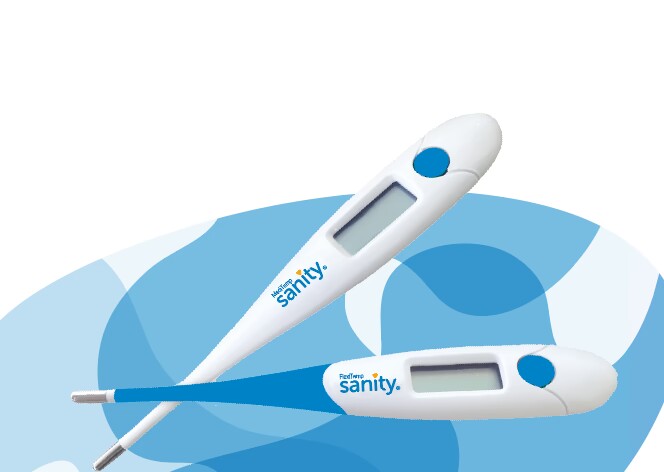
The electronic range (MT-518, MT-519, MT-811, MT-801, ECT-1) shares the ±0.1 °C accuracy class but adds battery power, a 45-second response and a fever alarm.
Frequently Asked Questions
ISO 13485 is the quality management system standard applied to the design and manufacture of medical devices, and for a buyer it is the evidence that production, inspection and documentation are controlled rather than informal. Ningbo Hi-life Medical Technology Co., Ltd. states that it strictly adheres to the ISO 13485 quality management system, and its mercury-free liquid-in-glass thermometer (product code 7967) is certified to the CE MDR Certificate issued by SGS under certificate number CN24/00005535 for the EU/EEA market, with EN ISO 13485:2016 referenced as the applicable standard. The company also passed a BSCI audit in 2025, participated in the revision and compilation of the national standard GB1588-2024, and serves as the Secretariat Unit of the Body Temperature Measurement Professional Committee under CAMDI. When screening suppliers, match the certificate number, product code, market and validity dates against the exact device you plan to import.
Yes. Ningbo Hi-life Medical Technology Co., Ltd. operates OEM, ODM and private-label production models. The documented private-label capability profile covers logo printing, packaging, color and scale customization with an MOQ from 5,000 units, a 25–35 day lead time and 150,000 units monthly capacity. The documented OEM/ODM profile covers shell color, brand logo, packaging and software parameter customization with an MOQ from 3,000 units, a 30–40 day lead time and 200,000 units monthly capacity. Quality control on these programmes is stated as 100-percent functional and precision testing.
Budget planning for this category turns on four documented parameters rather than on a published price list: minimum order quantity, lead time, monthly production capacity and customization scope. Depending on the profile selected, MOQ starts at 3,000 units or 5,000 units, lead time is 30–40 days or 25–35 days, and monthly capacity is 200,000 units or 150,000 units. Export experience covers the EU, North America, Southeast Asia, Oceania, the Middle East and South America, and after-sales support includes remote guidance, a spare-parts solution and after-sales feedback handling. Because these variables move with packaging, labeling and scale customization, commercial terms are quoted per project rather than from a fixed list.
Validation should be built around the inspection model rather than around a single sample unit. Hi-life states 100-percent functional and precision testing in production and 100-percent accuracy inspection before shipment, backed by in-house testing laboratories and full-process quality monitoring from raw-material incoming inspection to finished-product delivery. A buyer can therefore request the accuracy specification, the referenced standard and the CE MDR certificate scope in advance, then plan a destination-side incoming inspection that repeats the comparison check against a traceable reference. Sample arrangements, technical documentation and the current catalogue can be requested directly from the manufacturer before an order is placed.
Lead time is documented at 25–35 days for the private-label profile and 30–40 days for the OEM/ODM profile, with monthly capacity of 150,000 units and 200,000 units respectively. For a launch plan, that means tooling, artwork and packaging approval should be completed before the production window opens, and the certificate validity period (2026-01-22 to 2029-08-30 for certificate CN24/00005535) should be checked against your intended import schedule. To confirm current lead time for your configuration, request a quotation and a sample from the manufacturer at the start of the evaluation stage.
Conclusion: Specifying a Mercury-Free Glass Thermometer on Parameters, Not Labels
The 6000-A and 7000-A are defined by four verifiable parameters: a 35 °C–42 °C range, a 0.1 °C scale division, ±0.1 °C measurement accuracy, and a construction of borosilicate glass with a non-toxic gallium-indium-tin alloy. The maximum temperature indicator and the shock-resistant glass tube are the two design features that shape how the device is used, and the absence of a battery is the parameter that most clearly separates it from the electronic range. Together they support a device that is accurate, reusable and free of power dependency — but manual to read, and without alarms or memory.
For a buyer in the research and evaluation stage, the decision reduces to three questions: does the accuracy specification match your measurement requirement, does the certificate scope name the product code and market you are importing into, and does the handling model fit your clinical or homecare workflow. Answering those three questions with documented values is what turns a specification sheet into a sourcing decision.
Next step — samples, specifications and catalogue
Ningbo Hi-life Medical Technology Co., Ltd. supplies mercury-free liquid-in-glass thermometers (6000-A, 7000-A) and electronic thermometers (MT-518, MT-519, MT-811, MT-801, ECT-1) to distributors, medical institutions and healthcare wholesalers. Sample requests, quotation requests and OEM/ODM enquiries can be sent directly:
Email: byron.pan@hilife-med.com | Tel / WhatsApp: +86 139-5788-8585 | WhatsApp: start a conversation
Website: www.hilife-med.com | Full product catalogue: download the 2025 Hi-life Medical catalogue (PDF)
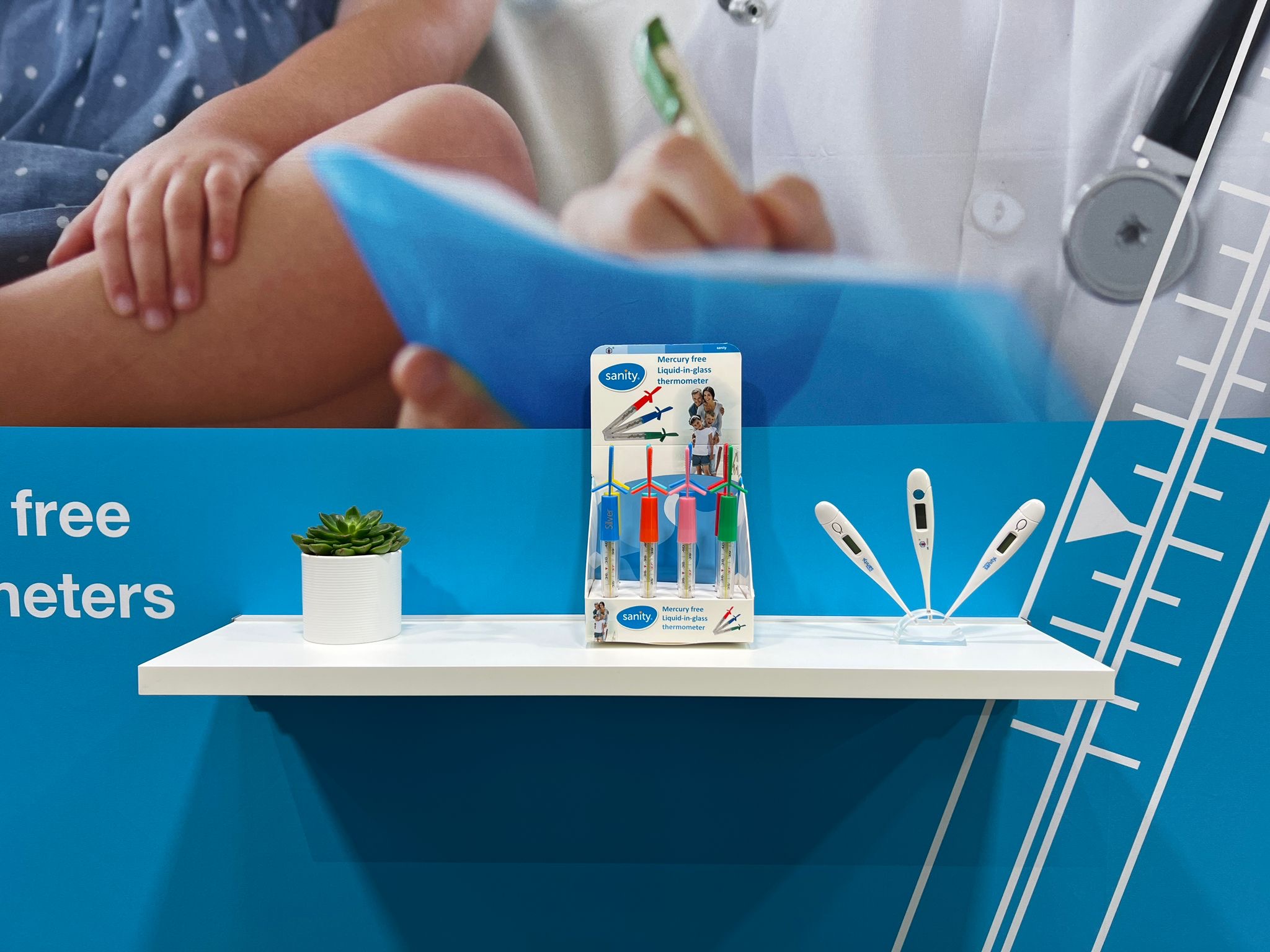
Mercury-free liquid-in-glass and electronic clinical thermometers displayed at an international medical exhibition.
Have Questions or Need More Details?
Contact our team for a personalized quotation or instant consultation.
Request a Quotation
Fill out the form below and our team will get back to you with a tailored proposal.
WhatsApp Direct Chat
Prefer to chat in real-time? Message us on WhatsApp for instant assistance & quick answers.
- Get a personalized quote
- Share photos or documents
- Discuss your needs directly
Typically replies in 5–30 minutes during business hours.