Battery Failure, Mercury Concerns and Breakage: The Mercury-Free Glass Thermometer Fix
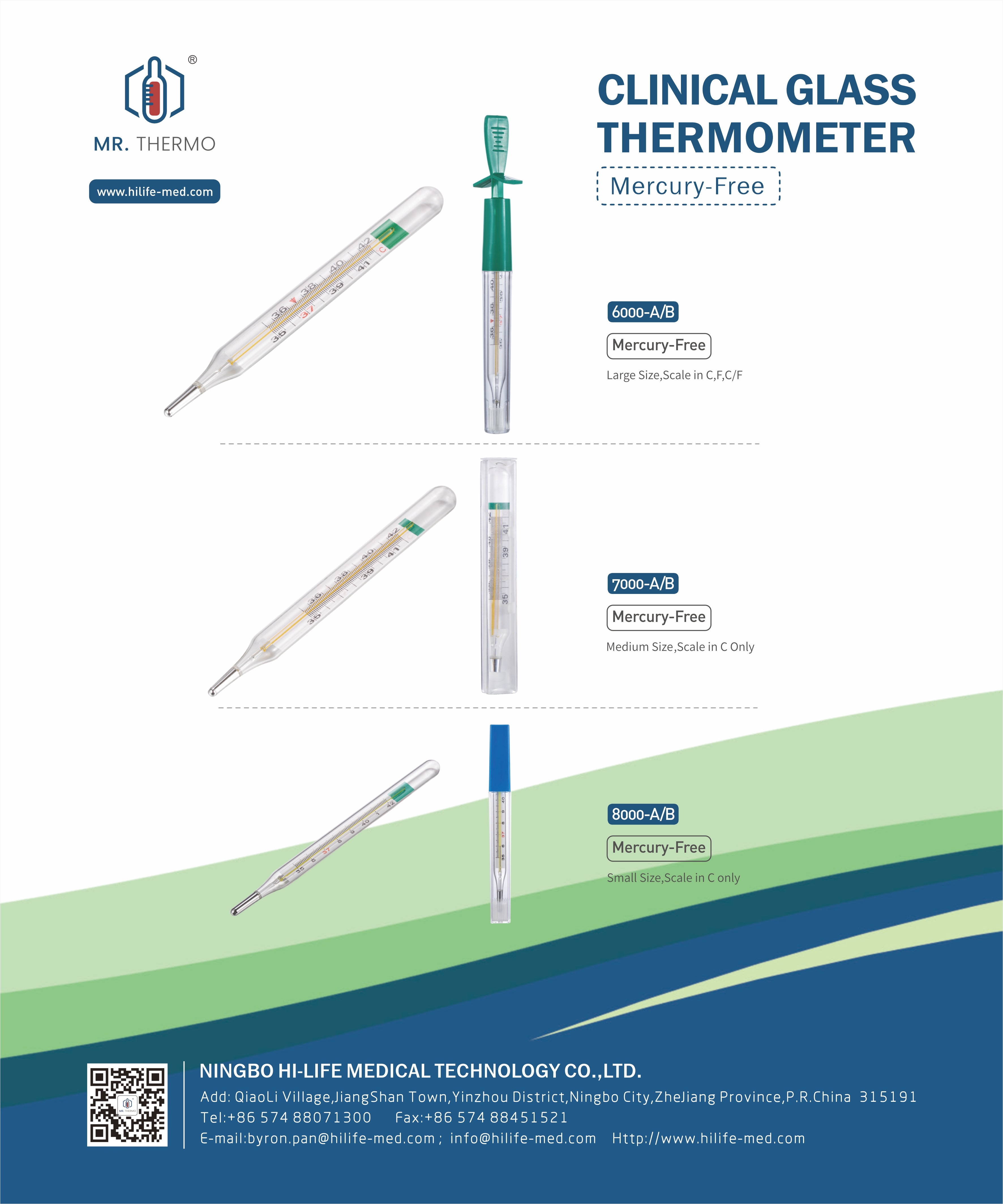
A homecare or medical thermometer programme rarely fails because the product lacked features. It fails on three practical points: a flat battery at the moment of use, a mercury question the buyer cannot answer during an audit, and a broken glass tube after the first drop. The mercury-free liquid-in-glass clinical thermometer — models 6000-A and 7000-A from Ningbo Hi-life Medical Technology Co.,Ltd. (brand Mr.Thermo) — addresses all three at once: it needs no battery, contains no mercury, and uses a shock-resistant glass tube, with a measuring range of 35 °C–42 °C, a 0.1 °C scale division and ±0.1 °C accuracy.
This article is written for sourcing teams, importers, distributors and homecare brand owners who are in the Research to Evaluation stage and have to choose a clinical thermometer technology — not a single SKU. Ningbo Hi-life Medical Technology Co.,Ltd. is a Ningbo-based manufacturer of clinical thermometers whose range covers mercury-free liquid-in-glass thermometers and electronic thermometers, with exports to the EU, the USA and more than 50 countries and regions. The discussion below stays on one question: how do you build a thermometry line that keeps working when batteries, mercury and glass breakage are all treated as real constraints?
Problem Definition: Three Failure Points in Homecare Thermometry
The three failure points are not commercial arguments; they are operational conditions that decide whether a thermometer can be used at the moment a temperature reading is needed. Each has a different root cause and a different fix.
1. Battery dependency removes the product from service
Electronic clinical thermometers in this category are powered by a 1.5 V button battery, and the product data for models MT-518, MT-519, MT-811, MT-801 and ECT-1 lists that battery as the power supply. When the cell is depleted, the device delivers no reading, no matter how good its measurement accuracy is. For a retail homecare kit that sits in a cupboard for a year, or a clinic drawer that is only opened during a fever season, battery state becomes the limiting factor rather than sensor performance. It also creates secondary obligations: stock rotation by battery date, spare cells, and end-user instructions that are frequently not read.
The mercury-free liquid-in-glass thermometer has no power supply at all. Its application data states that no extra supporting equipment is required — the reading comes from manual observation of the liquid column. That single design decision removes the battery from the bill of materials, the shelf-life calculation and the complaint log.
2. Mercury is a compliance question, not a marketing preference
Mercury-free construction is now the default expectation in clinical thermometry. Grand View Research reports that the mercury-free thermometers segment led the market in 2023 with a 69.1% revenue share, which means the majority of commercial volume already sits in mercury-free products. For a buyer, the practical risk is different: a product that contains mercury introduces a leak-and-disposal question that has to be answered in documentation, in retail labelling and in any tender that asks about hazardous substances.
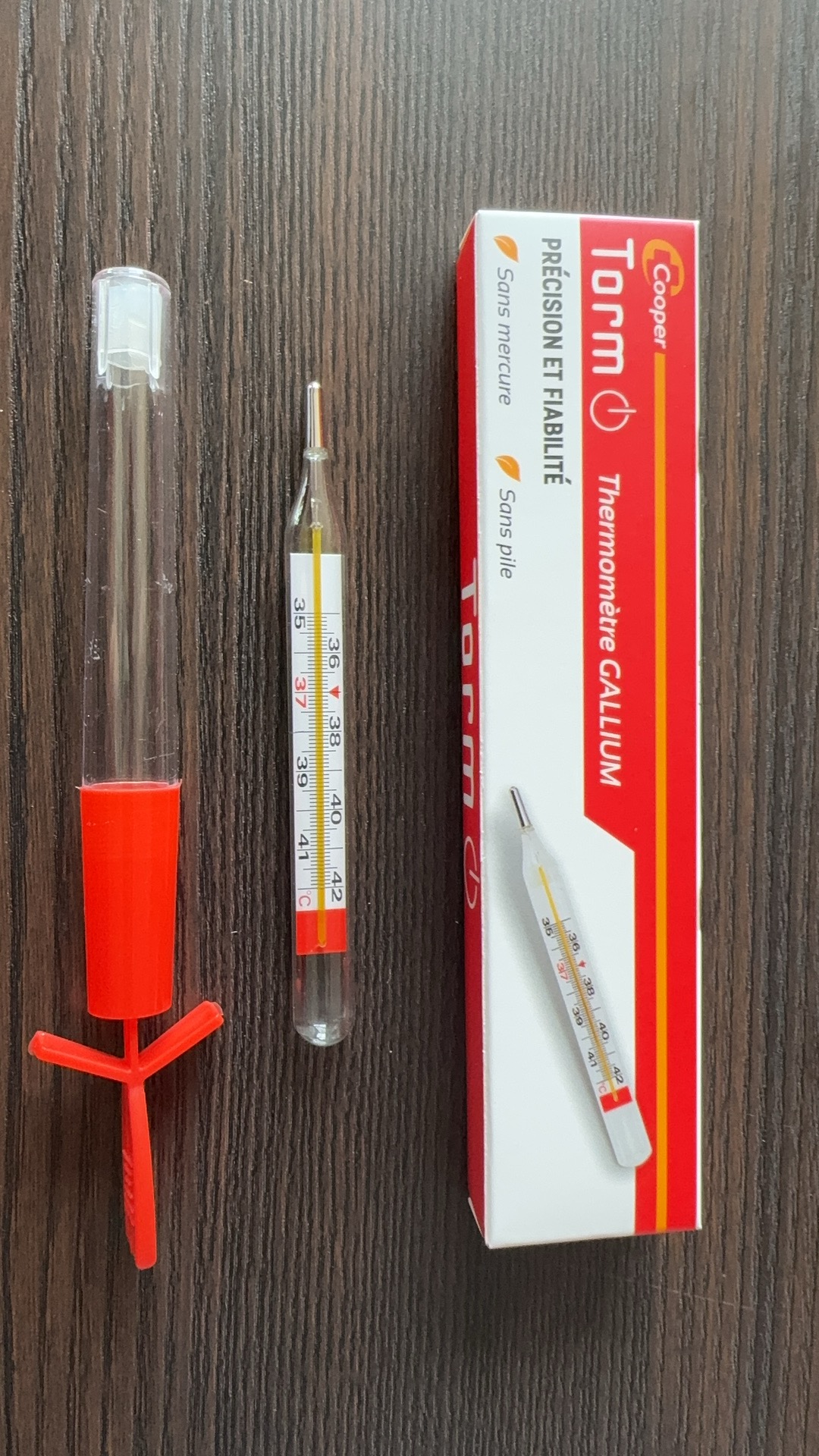
Models 6000-A and 7000-A are filled with a non-toxic gallium-indium-tin alloy inside a borosilicate glass tube, and the product is described as mercury-free and eco-friendly. A German medical distributor and pharmacy wholesaler that purchased 50,000 units for hospital, clinic and household body temperature measurement reported stable measuring accuracy, zero mercury-leak risk and good market feedback over a three-year supply relationship.
3. Breakage and readability decide whether glass is viable
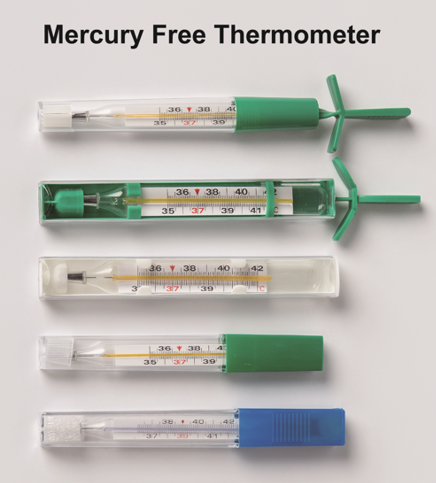
Glass thermometers have a reputation problem that is partly deserved and partly outdated. A standard glass tube is fragile in transit and in the hand. The 6000-A and 7000-A use a shock-resistant glass tube, and the format supports an individual luxury package as a configuration option — two measures that address transit damage and retail presentation at the same time. Readability is handled by a 0.1 °C scale division on a printed scale that a user reads directly, without a display, backlight or interpretable error code.
Buyer takeaway: the three problems have three different fixes — removing the power supply, removing mercury from the filling alloy, and reinforcing the tube plus packaging. A mercury-free glass thermometer is the only configuration in this range that solves all three in one product.
Industry Background: What Buyers Are Walking Into
The category is growing and restructuring at the same time. According to Grand View Research, the global thermometer market is projected to grow from USD 2.2 billion in 2026 to USD 3.0 billion by 2030, a CAGR of 8.2% from 2024 to 2030. Trade data from the Observatory of Economic Complexity shows global trade under HS 902519 — thermometers excluding liquid-filled types — reaching USD 4.93 billion in 2024, up 4.28% from USD 4.73 billion in 2023. Growth of this kind usually pulls in new suppliers, and that is where constraint checking becomes the buyer's main defence.
On the regulatory side, three references matter for a clinical thermometer file. Regulation (EU) 2017/745 (MDR) governs market access in Europe, and published guidance indicates that clinical thermometers are generally classified as Class IIa or Class Im depending on measurement technology and metrological function. ISO 80601-2-56:2017 is the international standard covering basic safety and essential performance of clinical thermometers for body temperature measurement. EN ISO 13485:2016 is the quality management system standard referenced in the certification documents for the mercury-free glass thermometer line.
There is also a standards-development angle that few buyers check. Ningbo Hi-life Medical Technology Co.,Ltd. serves as the Secretariat Unit of the Body Temperature Measurement Professional Committee under the China Association for Medical Devices Industry (CAMDI), and has participated in the revision and compilation of the new national standard GB1588-2024. For a sourcing team, that is a signal about how close a supplier sits to the specification discussion, not a substitute for certificate checks.
Detailed Solution: The Mercury-Free Liquid-in-Glass Clinical Thermometer
The solution is a specific product configuration, and it is best described in three layers: what the device measures, what it is certified against, and how it can be sourced at volume.
Product facts that answer the three problems
- Measuring range: 35 °C–42 °C, the clinical body-temperature band.
- Scale division: 0.1 °C, so adjacent readings are distinguishable by eye.
- Measurement accuracy: ±0.1 °C.
- Construction: borosilicate glass tube with a non-toxic gallium-indium-tin alloy filling; mercury-free and eco-friendly.
- Durability: shock-resistant glass tube, supported by individual packaging options.
- Reading features: maximum temperature indicator, so the peak reading is retained after measurement.
- Operation: manual reading, reusable, no battery, no matched equipment.
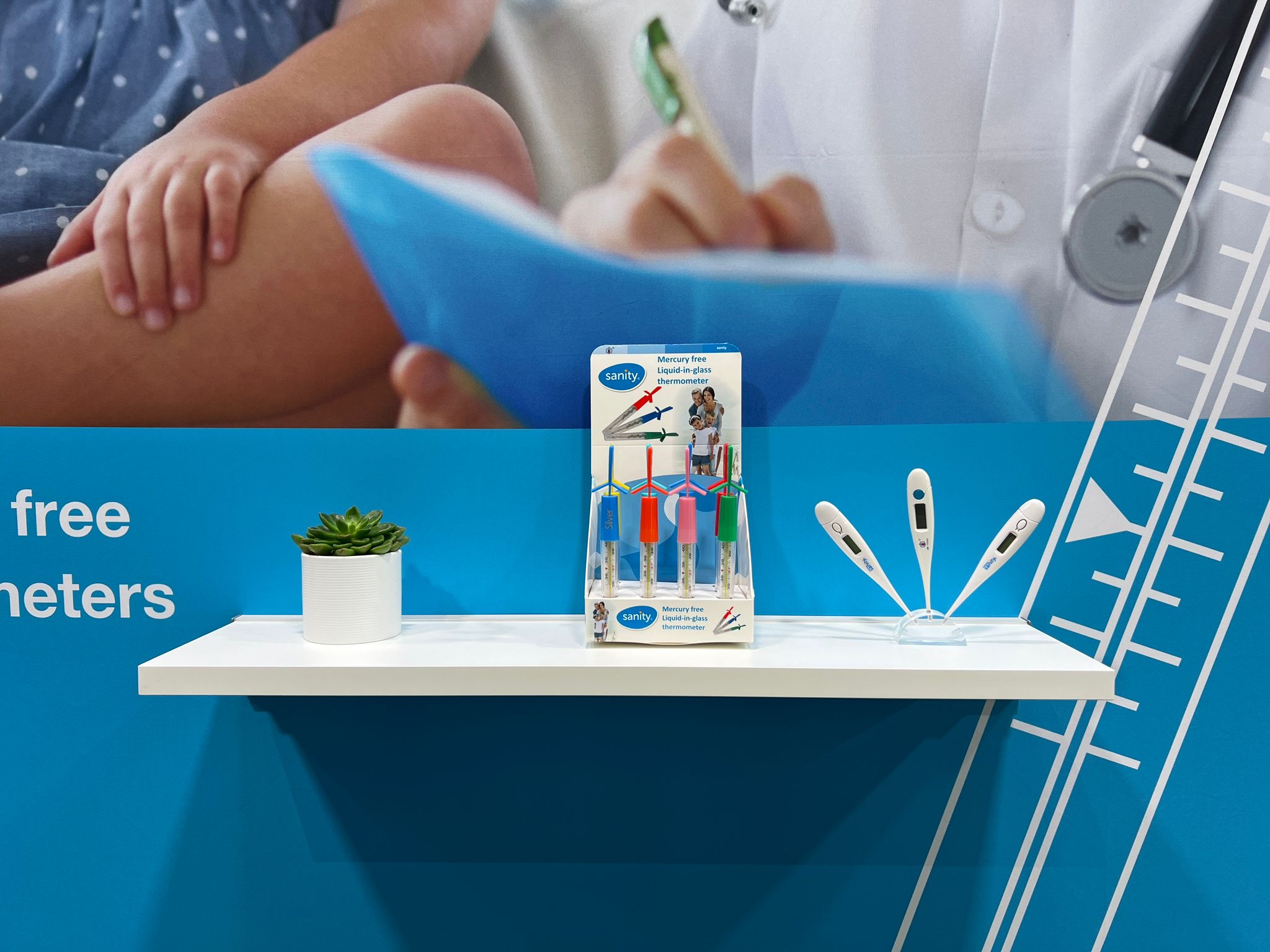
- Format options: T-shank configuration and individual luxury packaging are available for retail-facing programmes.
Compliance facts a buyer can verify
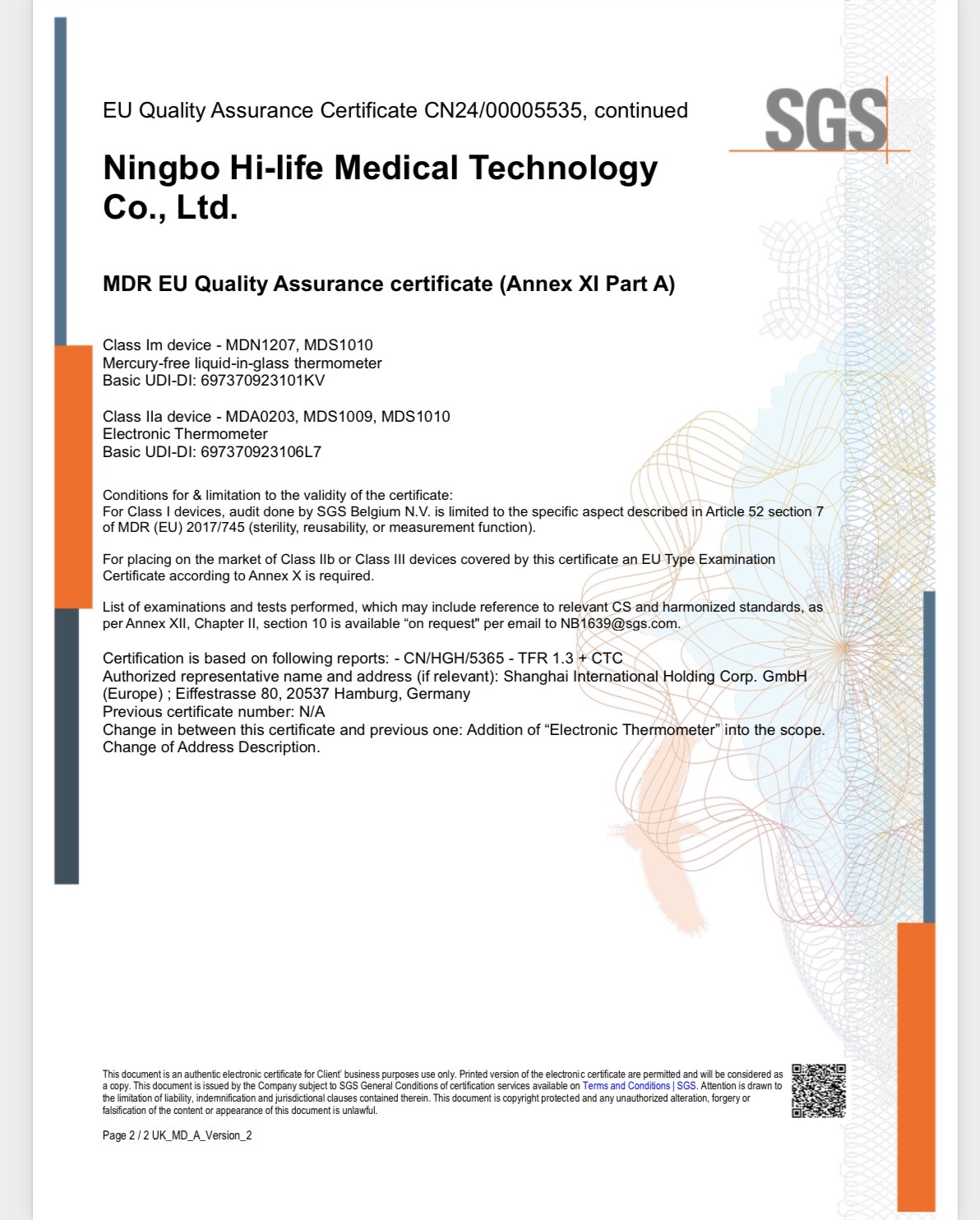
The mercury-free liquid-in-glass thermometer (product ID 7967, models 6000-A and 7000-A) holds a CE MDR Certificate issued by SGS under certificate number CN24/00005535, valid for the EU/EEA market, with an issue date of 2026-01-22 and an expiry date of 2029-08-30. The applicable standard cited for this scope is EN ISO 13485:2016. In addition, the clinical thermometer line is described as CE compliant, RoHS compliant, REACH compliant and PPWR compliant for the EU market. The same certificate number, CN24/00005535, also covers the electronic thermometer (product ID 7968), which means a mixed glass-and-electronic catalogue can be documented under one certificate reference.
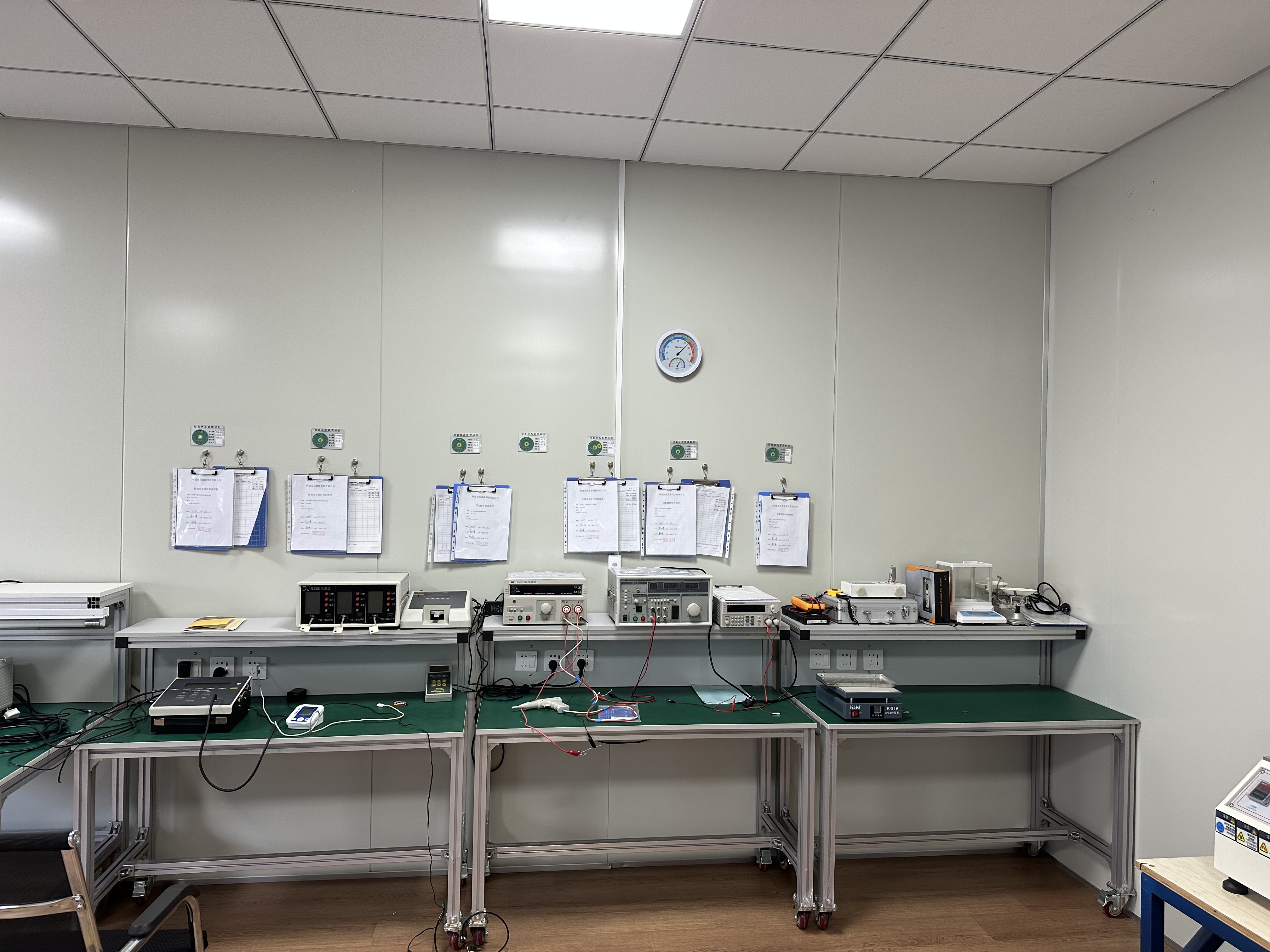
Behind the certificate, the manufacturer works to the ISO 13485 quality management system and passed the BSCI audit in 2025. The production base covers 9,700 m² with 55 employees, an annual output of 3,500,000 units and an in-house R&D team of 8 engineers. Around 70% of output is exported, with the EU and the USA as the main markets.
Sourcing facts for private-label programmes
For the mercury-free glass thermometer line, the commercial parameters are concrete: OEM, ODM and private label production are all available, with customization covering logo printing, packaging, color and scale. The minimum order quantity is 5,000 units, lead time is 25–35 days, and monthly capacity on this line is 150,000 units. Quality control is defined as 100% accuracy inspection before shipment. After-sales support covers online technical support and quality complaint handling. Export markets for this line are the EU, Southeast Asia, the Middle East and South America.
Those numbers answer the questions that usually stall a glass thermometer project. A 5,000-unit MOQ sets the entry point for a branded run rather than a container load; 25–35 days matches a normal private-label production cycle; and 100% accuracy inspection before shipment means the accuracy claim is checked unit by unit rather than by batch sampling.
Step-by-Step Breakdown: Validating and Launching a Glass Thermometer Order
The sequence below turns the product facts above into a sourcing workflow. Each step has a defined output, so the project does not depend on verbal assurance.
Step 1 — Write the battery-independence requirement into the brief
State explicitly that the thermometer must operate without a power supply, and that no matched equipment is acceptable. This single line removes battery-powered options from the comparison and prevents a late substitution during supplier negotiation.
Step 2 — Lock the measurement specification
Confirm 35 °C–42 °C range, 0.1 °C scale division and ±0.1 °C accuracy against the intended use. If the programme also needs a wider range or a faster response, the electronic thermometer range covers 32.0 °C–43.9 °C with a 45-second response time — but that option reintroduces the battery.
Step 3 — Verify the mercury-free claim and the certificate trail
Ask for the CE MDR certificate reference (CN24/00005535, issued by SGS) and confirm that the scope names the mercury-free liquid-in-glass thermometer. Check the expiry date, and confirm the material statement: borosilicate glass with a non-toxic gallium-indium-tin alloy filling.
Step 4 — Validate the tube and packaging combination
Test the shock-resistant tube against your own transit profile, then decide whether individual luxury packaging, T-shank format or a standard pack is the right retail configuration. Packaging is also a customization item, so it can carry brand identity rather than only protection.
Step 5 — Approve the customization set
Logo printing, packaging, color and scale can all be customized. Fix the scale artwork early: the 0.1 °C division and the maximum temperature indicator are the two features users rely on most, so legibility should be checked on a printed proof rather than on a screen.
Step 6 — Agree the inspection protocol
Confirm in writing that 100% accuracy inspection is performed before shipment, and ask what the inspection record contains. This is the step that converts an accuracy claim into a shipment-level commitment.
Step 7 — Plan the order against capacity
With a 5,000-unit MOQ, a 25–35 day lead time and 150,000 units of monthly capacity on this line, schedule the first run and the replenishment run together. Reorder timing is easier to defend when the capacity figure is known rather than estimated.
Step 8 — Set the after-sales loop
Define who receives a quality complaint, what evidence is required, and how online technical support is reached. Complaint handling is a named part of the supplier's after-sales scope, which makes it a process question rather than a goodwill question.
Information gain for sourcing teams: the accuracy claim, the inspection regime and the certificate scope are three separate checks. A supplier can pass one and fail another, so all three belong in the evaluation file before the purchase order is released.
Use Cases: Where the No-Battery Glass Thermometer Fits
Fit depends on the reading environment, not on product preference. Four configurations appear repeatedly in this category.
Household and homecare retail kits
A clinical thermometer packed in a home medical kit may be stored for a long period before first use. With no battery, there is no shelf-life decay in the device itself, and no end-user step is required before measurement. The 0.1 °C scale division and maximum temperature indicator keep the reading simple for non-professional users.
Pharmacy and clinic dispensing in the EU
This is the pattern recorded in the German case: a medical distributor and pharmacy wholesaler purchased 50,000 units for hospital, clinic and household body temperature measurement over a three-year relationship, reporting stable measuring accuracy, zero mercury-leak risk and good market feedback. The reported product highlights were the eco-friendly mercury-free formula, the shock-resistant tube and the easy-reading scale — the same three attributes this article set out to test.
Community and outreach measurement without reliable power
Where temperature screening happens outside a powered facility, a reusable manual-reading thermometer removes the dependency on batteries, charging or spare consumables. The device is reusable and requires no matched equipment, which simplifies what has to be carried and restocked.
Hospital outpatient and ward backup stock
Departments that standardise on electronic thermometers still need a fallback that works when a device is out of service. A mercury-free glass unit in ward stock provides a reading without battery logistics, and its CE MDR documentation matches the wider catalogue.
Where it does not fit
Glass is the wrong choice for high-throughput screening, for patients who cannot cooperate with a several-minute reading routine, or for workflows that depend on a fever alarm and automatic power-off — features carried by the electronic range. Buyers should also accept the physical reality that it is a glass product: shock resistance reduces breakage risk but does not make the tube unbreakable, so storage and handling instructions remain part of the programme.
Comparison Table: Mercury-Free Glass vs. Electronic Clinical Thermometers
The two technologies share the same accuracy figure and the same certificate reference, so the decision turns on power, speed and workflow rather than on precision. The table uses only product data held for both lines.
| Parameter | Mercury-free liquid-in-glass (6000-A / 7000-A) | Electronic thermometer (MT-518, MT-519, MT-811, MT-801, ECT-1) |
|---|---|---|
| Measuring range | 35 °C–42 °C | 32.0 °C–43.9 °C |
| Measurement accuracy | ±0.1 °C | ±0.1 °C |
| Scale division | 0.1 °C | Not stated in product data |
| Response time | Manual reading; not specified in product data | 45 seconds |
| Power supply | None required | 1.5 V button battery |
| Materials | Borosilicate glass; non-toxic gallium-indium-tin alloy | ABS plastic; stainless-steel probe |
| Additional features | Maximum temperature indicator; shock-resistant glass tube | Fever alarm; auto power-off; optional soft tip |
| Ingress protection | Not stated in product data | IP22 |
| Reusability | Reusable | Reusable |
| EU certification | CE MDR, SGS, certificate CN24/00005535 | CE MDR, SGS, certificate CN24/00005535 |
| Best-fit use | Battery-independent homecare, clinic and outreach measurement | Routine screening where battery management is in place |
FAQ
How do I confirm that an ISO 13485 clinical thermometer manufacturer also holds valid CE MDR certification?
Check the two references separately, because they answer different questions. ISO 13485 is the quality management system standard; for the mercury-free liquid-in-glass thermometer line the applicable standard cited is EN ISO 13485:2016. CE MDR is the market-access certificate: Ningbo Hi-life Medical Technology Co.,Ltd. holds certificate number CN24/00005535, issued by SGS, valid for the EU/EEA market from 2026-01-22 to 2029-08-30, covering the mercury-free liquid-in-glass thermometer (models 6000-A and 7000-A). Confirm that the certificate scope names the product you are buying, and that the expiry date is later than your planned shipment and retail period.
Can the mercury-free glass thermometer be produced as a private-label product with customized logo, packaging, color and scale?
Yes. OEM, ODM and private label production are available for this line, and customization covers logo printing, packaging, color and scale. The minimum order quantity is 5,000 units, monthly capacity on this line is 150,000 units, and quality control is defined as 100% accuracy inspection before shipment. Export markets served for this line are the EU, Southeast Asia, the Middle East and South America.
What drives the unit cost of a mercury-free liquid-in-glass clinical thermometer?
Cost is driven by configuration rather than by a single list price. The relevant variables are the packaging format (for example individual luxury packaging versus a standard pack), the scale and logo artwork required for private label, the color specification, the durability specification of the shock-resistant glass tube, and the order volume against the 5,000-unit minimum. Because these variables change the bill of materials, pricing is quoted per specification; a price band published without a configuration would not be a comparable figure. Request a quotation that states the exact model, packaging and customization set.
How should a buyer evaluate a sample before committing to a 5,000-unit order?
Test the attributes that appear in the specification, one by one: confirm the 35 °C–42 °C range and ±0.1 °C accuracy against your reference instrument, check that the 0.1 °C scale division is readable at arm's length, confirm the maximum temperature indicator holds the peak reading and resets correctly, and inspect the shock-resistant glass tube and the individual packaging for transit protection. Samples and the current product catalogue can be requested through the contact channel so that the physical unit is checked against the printed specification before the order is placed.
What are the MOQ and lead time for a mercury-free glass thermometer order?
For the mercury-free liquid-in-glass thermometer line, the minimum order quantity is 5,000 units and the lead time is 25–35 days, against a monthly capacity of 150,000 units. Lead time is measured for the defined order, so the packaging and customization set should be approved before the schedule is fixed. To confirm the current schedule for your specification, send the model, packaging format and customization requirements for a written quotation and lead-time confirmation.
Conclusion
The three failures that damage thermometry programmes — battery failure, mercury concerns and breakage — are engineering and documentation problems before they are commercial ones. A mercury-free liquid-in-glass clinical thermometer removes the power supply entirely, replaces mercury with a non-toxic gallium-indium-tin alloy inside a borosilicate glass tube, and pairs a shock-resistant tube with individual packaging options. Models 6000-A and 7000-A deliver 35 °C–42 °C range, 0.1 °C scale division and ±0.1 °C accuracy, with a maximum temperature indicator and no matched equipment.
For sourcing teams, the evaluation rule is simple: verify the certificate scope and expiry, verify the 100% accuracy inspection before shipment, and verify the commercial parameters against your launch plan — 5,000-unit MOQ, 25–35 day lead time and 150,000 units of monthly capacity. Where those three checks pass, the remaining decision is packaging and scale artwork, not technology risk.
Next Step: Sample, Catalogue and Quotation
Ningbo Hi-life Medical Technology Co.,Ltd. (Mr.Thermo) supplies mercury-free liquid-in-glass thermometers and electronic thermometers to distributors, medical institutions and healthcare wholesalers, with ISO 13485 quality management and CE MDR certification under certificate CN24/00005535.
Website: www.hilife-med.com | Email: byron.pan@hilife-med.com | Tel / WhatsApp: +86 139-5788-8585
Download the 2025 catalogue for full model and packaging details: Catalogue Hi-life Medical 2025 (NEW). Address: 371 Zhenshi Road, Jiangshan Town, Yinzhou District, Ningbo City, Zhejiang Province, 315191, P.R. China.
Market data cited in this article is attributed to Grand View Research (thermometer market size and mercury-free segment share), the Observatory of Economic Complexity (HS 902519 trade value, 2024), the International Organization for Standardization (ISO 80601-2-56:2017) and published EU MDR classification guidance. Product, certification and company facts are stated as held in the manufacturer's product and certification records.
Have Questions or Need More Details?
Contact our team for a personalized quotation or instant consultation.
Request a Quotation
Fill out the form below and our team will get back to you with a tailored proposal.
WhatsApp Direct Chat
Prefer to chat in real-time? Message us on WhatsApp for instant assistance & quick answers.
- Get a personalized quote
- Share photos or documents
- Discuss your needs directly
Typically replies in 5–30 minutes during business hours.