Partnering for the Long Run: OEM Terms, Lead Times and After-Sales Support for Clinical Thermometer Importers
Short answer
An OEM clinical thermometer program with NINGBO HI-LIFE MEDICAL TECHNOLOGY CO.,LTD (Mr.Thermo) is offered in two documented structures. One starts at a 3,000-unit MOQ with a 30–40 day lead time and up to 200,000 units of monthly capacity; the other starts at a 5,000-unit MOQ with a 25–35 day lead time and 150,000 units of monthly capacity. Both cover OEM, ODM and private label production, 100% pre-shipment function and precision testing, FOB Ningbo / CFR / CIF delivery terms, and 30% deposit with 70% balance against a copy of the shipping documents.
Most clinical thermometer sourcing conversations begin with a product and end with a purchase order. The terms that determine whether that purchase order is repeatable — minimum order quantity, standard lead time, the real limits of customization, and who answers when a carton arrives with a problem — are usually negotiated afterwards, in scattered emails, or not at all. For an importer moving from evaluation into execution, that sequencing is the single most expensive habit in the category.
NINGBO HI-LIFE MEDICAL TECHNOLOGY CO.,LTD (Mr.Thermo) is a Ningbo, China–based manufacturer of clinical thermometers whose range includes mercury-free liquid-in-glass thermometers and electronic thermometers, with exports concentrated in the EU and USA and OEM, ODM and private label production offered as standard modes. The operational answers below are taken from the company's published capability and purchasing documentation, so each one can be checked line by line against an actual quotation.
Why OEM Terms Decide Whether a Supply Relationship Survives
An OEM clinical thermometer program is not a price list. It is a set of commitments that must match in three places: the quotation, the pre-shipment inspection record, and the response an importer receives when something deviates. When any one of the three is silent, the importer absorbs the risk.
Three failure patterns recur most often. The first is MOQ drift — a trial order is quoted at one quantity, then the buyer discovers on reorder that the number was promotional rather than structural. The second is lead-time surprise, where a 25–35 day window is assumed to cover artwork approval, packaging print and inspection, and does not. The third is the after-sales vacuum: nobody establishes, before the first container, who provides technical guidance, whether spare parts are available, and how a quality complaint is formally handled.
The practical test for any long-term thermometer supplier is therefore narrow. Can the supplier state its MOQ, lead time, capacity, customization scope and after-sales scope in writing, and does the same document apply to order two as to order one? A supplier that answers those five questions precisely is a lower-risk partner than one that answers them generously.
Industry Background: A Mercury-Free Category Under Documented Rules
The commercial case for locking in a qualified thermometer supplier rests on two shifts that are already underway: product substitution and documentation burden.
On substitution, mercury-free thermometers led the global thermometer market in 2023 with a 69.1% revenue share, according to Grand View Research's thermometer market report. The same source projects the global thermometer market growing from USD 2.2 billion in 2026 to USD 3.0 billion by 2030. Trade data points the same direction: global trade under HS code 902519 — thermometers other than liquid-filled — reached USD 4.93 billion in 2024, per the Observatory of Economic Complexity.
On documentation, clinical thermometers sit inside regulated medical-device frameworks rather than general consumer goods. ISO 80601-2-56:2017 is the international standard covering basic safety and essential performance of clinical thermometers for body temperature measurement. Within the European Union, clinical thermometers are generally classified as Class IIa or Class Im under Regulation (EU) 2017/745 (MDR), depending on measurement technology and metrological function.
For an importer, the consequence is straightforward: every change of manufacturing source reopens technical files, test evidence and label review. A supplier relationship that is designed to last several years is cheaper than a cheaper supplier replaced every eighteen months — not because the unit price is lower, but because the compliance work is not repeated.
What a Long-Term Clinical Thermometer Partnership Actually Covers
The manufacturing base behind the terms
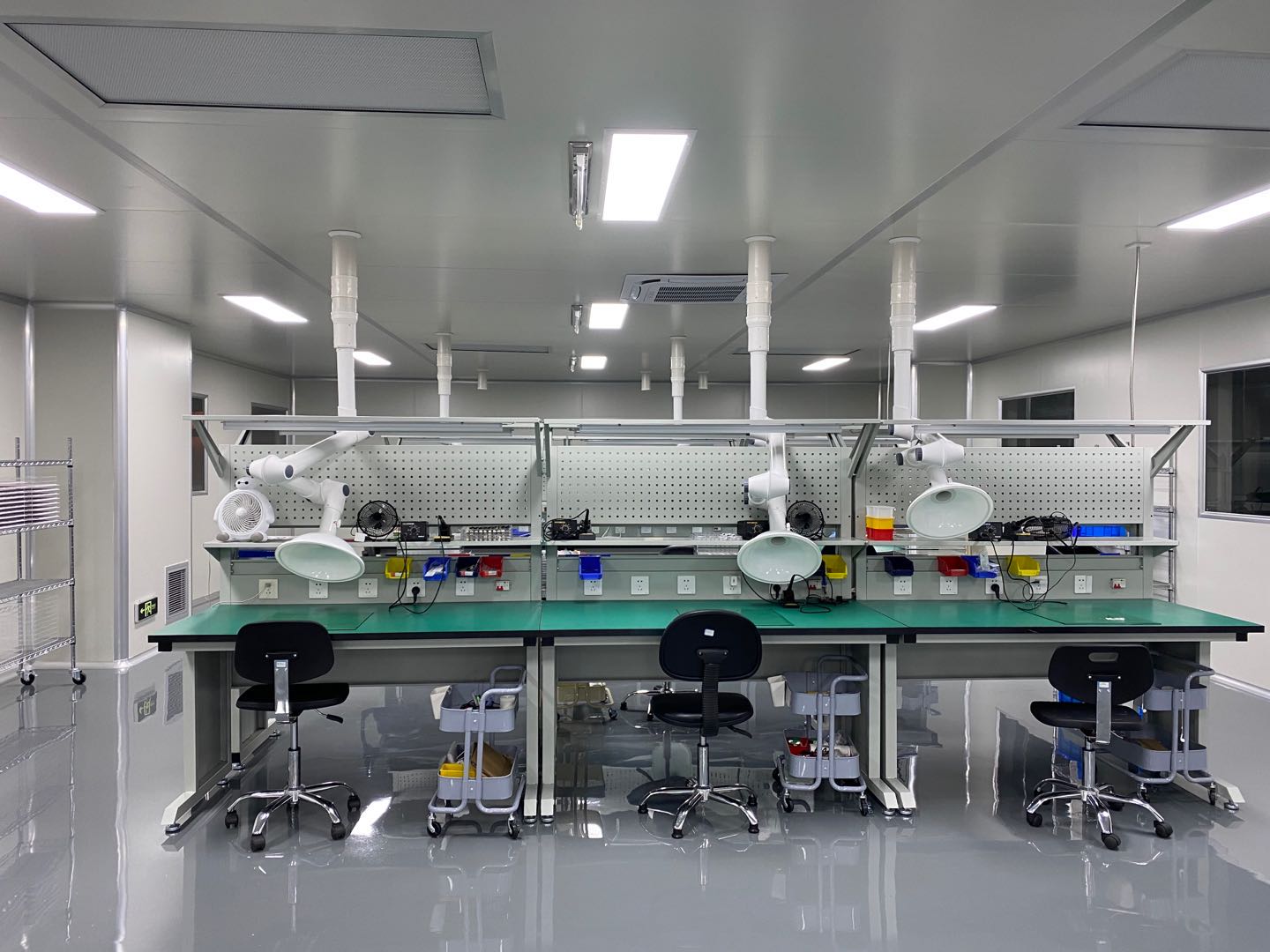
The terms in the two program structures are backed by a defined plant. The Ningbo facility covers 9,700 m² with 55 employees, an R&D team of 8 engineers, and an annual output of 3,500,000 units. Products are manufactured under an ISO 13485 quality management system, and the company passed a BSCI audit in 2025. It also participates in industry standard-setting, acting as the Secretariat Unit of the Body Temperature Measurement Professional Committee under the China Association for Medical Devices Industry (CAMDI), and has taken part in the revision and compilation of the national standard GB1588-2024. Exports run to more than 50 countries and regions, with roughly 70% of output going to the EU and USA.
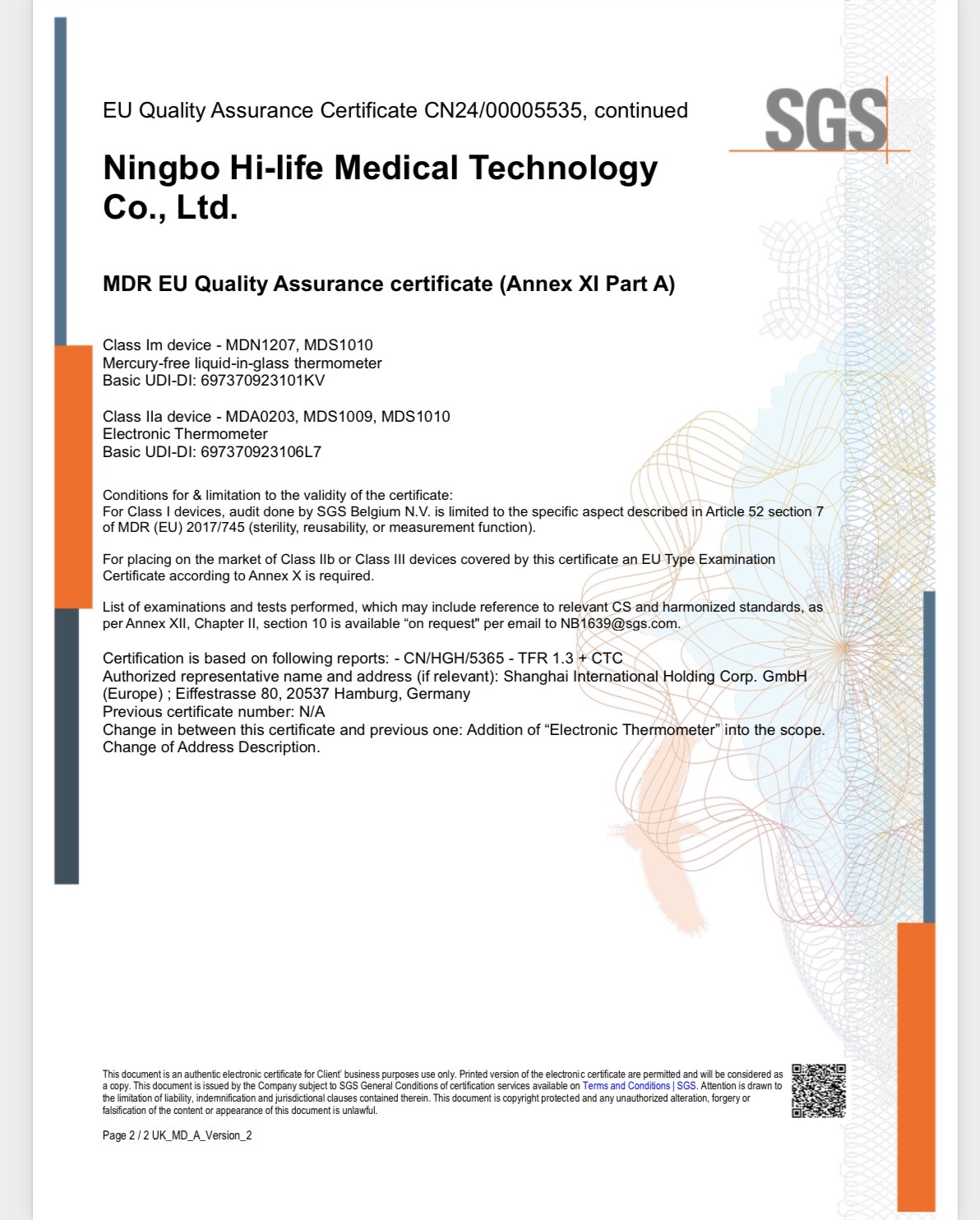
Compliance is documented rather than asserted. The mercury-free liquid-in-glass thermometer and electronic thermometer scopes are covered by CE MDR certificate CN24/00005535, issued by SGS on 2026-01-22 and valid to 2029-08-30 for the EU/EEA market. That single certificate, covering both product families, is what makes a multi-year OEM agreement practical for European buyers: the certificate validity window gives the partnership a planning horizon.
Three production modes, two documented structures
Production is offered as OEM, ODM, Private Label, or fully customized service. Behind that label sit two distinct operating structures, and importers should know which one their order falls into before they sign.
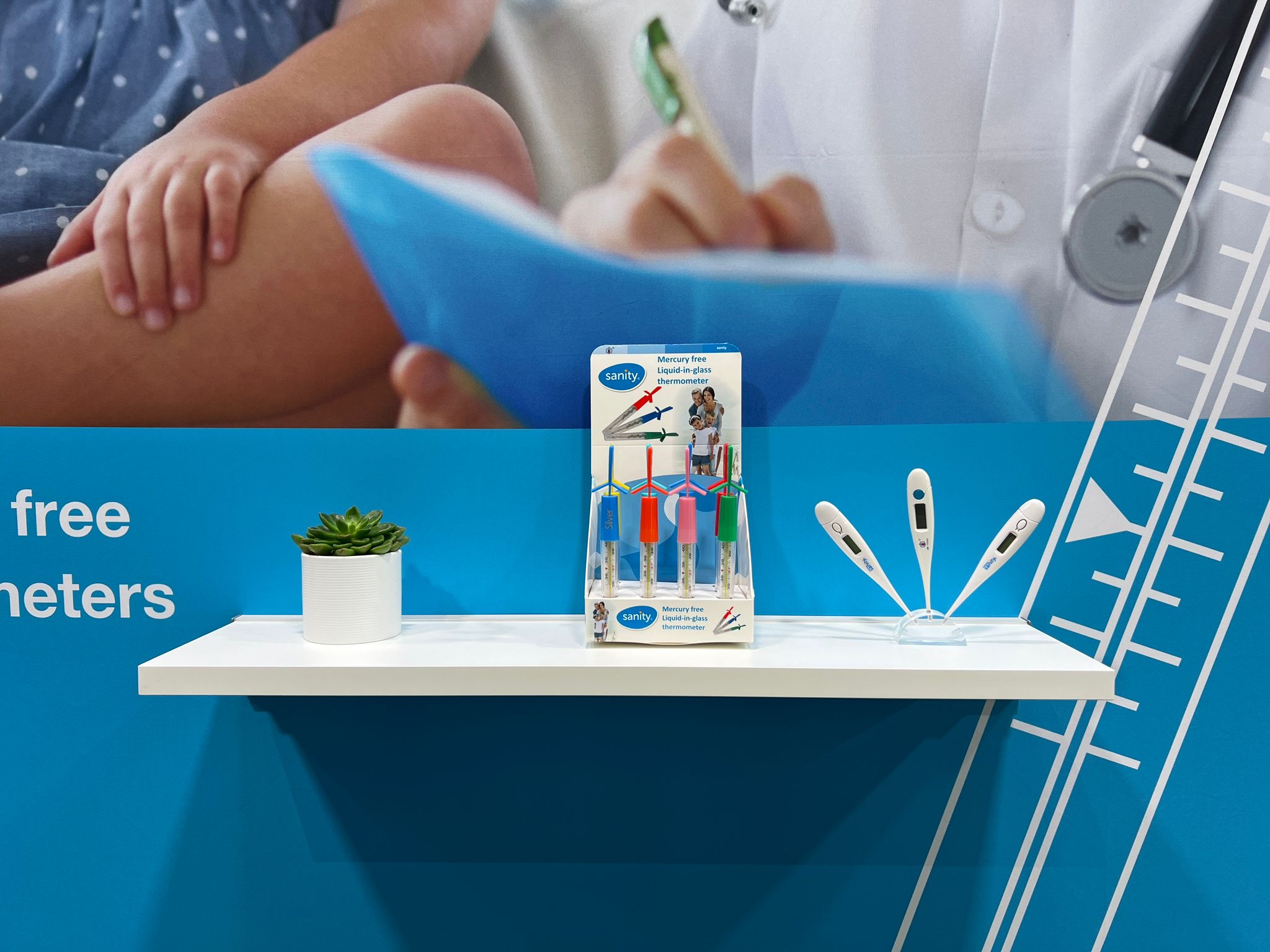
The first structure supports OEM, ODM and customized service, with monthly capacity of 200,000 units, a 3,000-unit MOQ and a 30–40 day lead time. Customization in this structure covers shell color, brand logo, packaging and software parameters — the last of which matters for electronic thermometer models where display behavior or alarm logic is set in firmware. Quality control is 100% functional and precision testing, and after-sales support includes remote guidance, a spare-parts solution and an after-sales feedback channel. Published export markets for this structure are the EU, North America, Southeast Asia and Oceania.
The second structure runs OEM, ODM and Private Label with monthly capacity of 150,000 units, a 5,000-unit MOQ and a 25–35 day lead time. Customization here is defined as logo printing, packaging, color and scale customization — scale customization being specific to glass thermometers, where the printed temperature scale is part of the product itself. Quality control is 100% accuracy inspection before shipment, and after-sales support covers online technical support and quality complaint handling. Published export markets are the EU, Southeast Asia, the Middle East and South America.
The difference is not cosmetic. The lower-MOQ structure carries the longer lead time and the wider customization menu; the higher-MOQ structure carries the shorter lead time and the narrower, print-and-scale-focused customization set. Importers who need private-label packaging on a first run usually fit the first structure; importers who need volume replenishment on a predictable cycle usually fit the second.
What after-sales support does and does not mean
Post-sale support in these two structures is operational, not promotional, and it is worth stating precisely so expectations match the contract. It consists of remote guidance (technical support delivered at a distance rather than by on-site engineers), a spare-parts solution for affected units, online technical support, quality complaint handling, and an after-sales feedback channel through which issues return into the quality system.
What that means for an importer is that the escalation path runs through documentation and parts rather than through a field-service visit. Buyers whose market requires on-site service should confirm that requirement explicitly before ordering; buyers distributing through pharmacy, homecare or clinical channels, where a replacement or a technical instruction resolves most cases, will find the published scope sufficient.
From Evaluation to Execution: Seven Steps to Activate an OEM Program
The sequence below converts the terms above into an order. Each step ends in a document, which is the point — verbal agreement is what fails at reorder.
- Fix the product platform first. Decide whether the program is built on the mercury-free liquid-in-glass range (models 6000-A and 7000-A) or the electronic range (MT-518, MT-519, MT-811, MT-801, ECT-1). The two platforms have different customization levers — scale printing on glass, firmware parameters on electronic — so the platform choice determines which structure fits.
- Select the production mode. Confirm whether the order is OEM, ODM, private label or fully customized. ODM work transfers design and production to the manufacturer; OEM and private label work keeps the buyer's brand and specification in front.
- Define the customization scope in writing. On the glass platform, scope covers logo printing, packaging and scale customization. On the electronic platform, scope extends to shell color, brand logo, packaging and software parameters. Anything outside those lists should be treated as a new request, not an assumed inclusion.
- Match the order to the correct MOQ and lead time. A 3,000-unit MOQ pairs with a 30–40 day lead time; a 5,000-unit MOQ pairs with a 25–35 day lead time. Plan artwork and packaging print approval inside that window rather than before it.
- Agree commercial and delivery terms. Delivery terms are FOB Ningbo, CFR, or CIF (destination port, depending on the structure). Payment terms are 30% deposit with 70% balance against a copy of the shipping documents.
- Set the acceptance criteria. Pre-shipment acceptance is 100% functional and precision testing. Customer inspection is supported, and third-party inspection is acceptable. Write the inspection right into the order so that it survives staff changes on either side.
- Confirm the after-sales route. Record who receives a complaint, what response is expected, and how spare parts are supplied. This is the step most often skipped and the one that determines whether year three happens.
Use Cases: Two Programs That Ran for Three Years
Two long-running programs show how the terms behave in practice.
A healthcare importer and supermarket retailer in France has ordered 100,000 units over a three-year relationship for home-use and community medical temperature screening. The configuration emphasized a fever alarm function, a portable size and an optional soft probe tip. The reported outcome was fast measurement, a low defective rate, and conformity with EU MDR requirements — the compliance point being decisive, since the buyer's channel requires documented conformity rather than supplier assurance.
A medical distributor and pharmacy wholesaler in Germany has ordered 50,000 units over three years for hospital, clinic and household body temperature measurement, on the mercury-free glass platform (models 6000-A and 7000-A). The reported outcome was stable measuring accuracy, zero mercury-leak risk and good market feedback, with the eco-friendly mercury-free formula, shock-resistant tube and easy-reading scale cited as the working advantages.
Both cases share one structural feature: the volume was spread across years rather than concentrated in one order. That is only possible when MOQ, lead time and after-sales scope are stable enough to be planned against — which is the entire argument for negotiating them at the start.
Comparison Table: The Two OEM Structures Side by Side
| Parameter | Structure A | Structure B |
|---|---|---|
| Production modes | OEM / ODM / Customized service | OEM / ODM / Private Label |
| Minimum order quantity | 3,000 units | 5,000 units |
| Standard lead time | 30–40 days | 25–35 days |
| Monthly capacity | 200,000 units | 150,000 units |
| Customization scope | Shell color, brand logo, packaging, software parameter | Logo printing, packaging, color, scale customization |
| Quality control | 100% functional & precision testing | 100% accuracy inspection before shipment |
| After-sales scope | Remote guidance, spare-parts solution, after-sales feedback | Online technical support, quality complaint handling |
| Published export markets | EU, North America, Southeast Asia, Oceania | EU, Southeast Asia, Middle East, South America |
The two product platforms the terms apply to
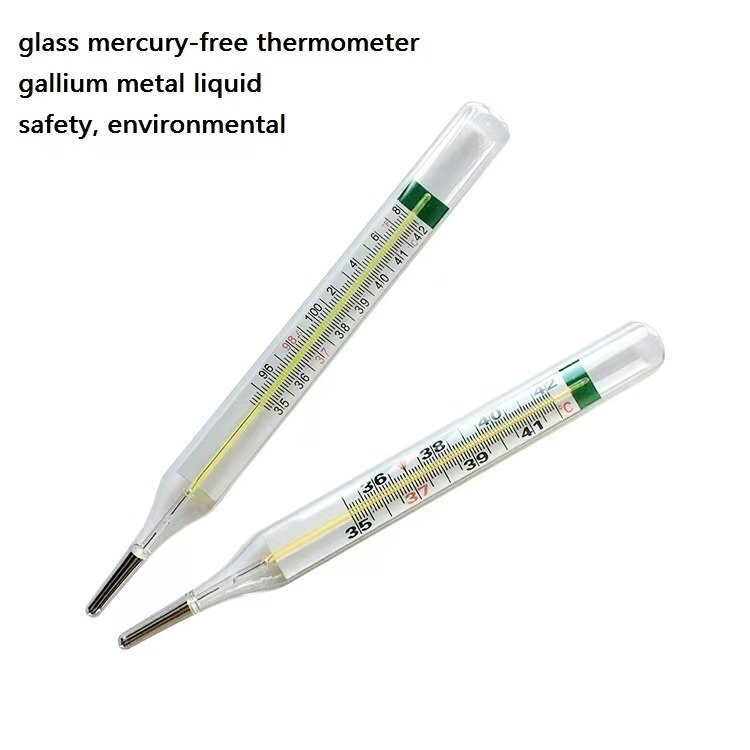
| Specification | Mercury-free liquid-in-glass (6000-A, 7000-A) | Electronic (MT-518, MT-519, MT-811, MT-801, ECT-1) |
|---|---|---|
| Measuring range | 35 °C – 42 °C | 32.0 °C – 43.9 °C |
| Accuracy | ±0.1 °C | ±0.1 °C |
| Scale division | 0.1 °C | Response time 45 seconds |
| Material | Borosilicate glass / non-toxic gallium-indium-tin alloy | ABS plastic / stainless-steel probe |
| Key features | Maximum temperature indicator, shock-resistant glass tube | IP22, 1.5V button battery, operating temperature 10 °C – 40 °C |
FAQ: OEM Terms, Lead Times and After-Sales Support
Does an OEM clinical thermometer program include EU compliance documentation?
Yes. The mercury-free liquid-in-glass and electronic thermometer scopes are covered by CE MDR certificate CN24/00005535, issued by SGS on 2026-01-22 and valid to 2029-08-30 for the EU/EEA market. Manufacturing follows the ISO 13485 quality management system, and the company passed a BSCI audit in 2025. Importers should note that the certificate validity window gives a defined planning horizon, so a multi-year OEM agreement should be reviewed against the expiry date rather than assumed to run indefinitely.
What can an importer customize on a mercury-free liquid-in-glass or electronic thermometer?
It depends on the structure. In the 3,000-unit structure, customization covers shell color, brand logo, packaging and software parameters. In the 5,000-unit structure, it covers logo printing, packaging, color and scale customization. Software parameters apply to electronic models such as MT-518, MT-519, MT-811, MT-801 and ECT-1; scale customization applies to the glass platform, where the printed scale is part of the product. OEM, ODM and private label modes are available in both.
What MOQ, payment terms and delivery terms apply?
The published minimum order quantity is 3,000 units in one structure and 5,000 units in the other. Delivery terms are FOB Ningbo, CFR, or CIF destination port depending on the structure. Payment terms are 30% deposit with 70% balance against a copy of the shipping documents. Acceptance criteria are 100% functional and precision pre-shipment testing, with customer inspection supported and third-party inspection acceptable.
How can an importer validate quality before shipment?
Validation happens at pre-shipment acceptance rather than only at the sampling stage. Both structures specify 100% testing rather than batch sampling — 100% functional and precision testing in the 3,000-unit structure, and 100% accuracy inspection before shipment in the 5,000-unit structure. Customer inspection is supported, and third-party inspection is acceptable. Writing the inspection method and the acceptance criteria into the purchase order is the practical safeguard, because it keeps the standard identical across reorders.
How long does production take, and can capacity support repeat orders?
Standard lead time is 30–40 days in the 3,000-unit structure and 25–35 days in the 5,000-unit structure, against monthly capacity of 200,000 units and 150,000 units respectively. Those figures matter most at reorder: a program sized against monthly capacity can absorb seasonal demand without renegotiating terms each cycle. Importers planning a first OEM run can request current program details and the product catalogue as a next step, then match their forecast to the structure whose MOQ, lead time and after-sales scope fit their channel.
Conclusion: Terms First, Volume Second
Long-term thermometer supply is decided by a small number of written commitments. For NINGBO HI-LIFE MEDICAL TECHNOLOGY CO.,LTD (Mr.Thermo), those commitments are specific: a 3,000-unit MOQ with a 30–40 day lead time and 200,000 units monthly capacity, or a 5,000-unit MOQ with a 25–35 day lead time and 150,000 units monthly capacity; OEM, ODM and private label modes; customization limited to defined lists on each structure; 100% pre-shipment function and precision testing with customer and third-party inspection accepted; FOB Ningbo, CFR or CIF delivery; 30% deposit and 70% balance against shipping documents; and after-sales support covering remote guidance, spare parts, online technical support and quality complaint handling.
An importer who maps their forecast against those five points — mode, MOQ, lead time, acceptance criteria, after-sales route — will know before the first container whether the relationship can hold for three years, which is exactly what the two long-running French and German programs did.
Next step
Review the full clinical thermometer range, specifications and customization options before opening an OEM, ODM or private label discussion.
Download the Hi-life Medical catalogue (PDF)
Website: www.hilife-med.com
Contact: Byron Pan | Email: byron.pan@hilife-med.com | Tel / WhatsApp: +86 139-5788-8585
Address: 371 Zhenshi Road, Jiangshan Town, Yinzhou District, Ningbo, Zhejiang 315191, P.R. China
Have Questions or Need More Details?
Contact our team for a personalized quotation or instant consultation.
Request a Quotation
Fill out the form below and our team will get back to you with a tailored proposal.
WhatsApp Direct Chat
Prefer to chat in real-time? Message us on WhatsApp for instant assistance & quick answers.
- Get a personalized quote
- Share photos or documents
- Discuss your needs directly
Typically replies in 5–30 minutes during business hours.