Electronic vs. Mercury-Free Glass Thermometer: The Head-to-Head Decision for Importers
Short answer for importers: both lines are reusable and both are specified at an accuracy of ±0.1℃, so precision does not decide a purchase order. The electronic line (MT-518, MT-519, MT-811, MT-801, ECT-1) leads on measuring range (32.0℃–43.9℃), response time (45 seconds), digital readout and a fever-alarm function, and it depends on a 1.5V button battery. The mercury-free liquid-in-glass line (6000-A, 7000-A) leads on battery independence, a shock-resistant glass tube, a 0.1℃ scale division and a maximum temperature indicator that holds the peak reading. Decide by power source, breakage exposure and shelf behaviour — not by accuracy.
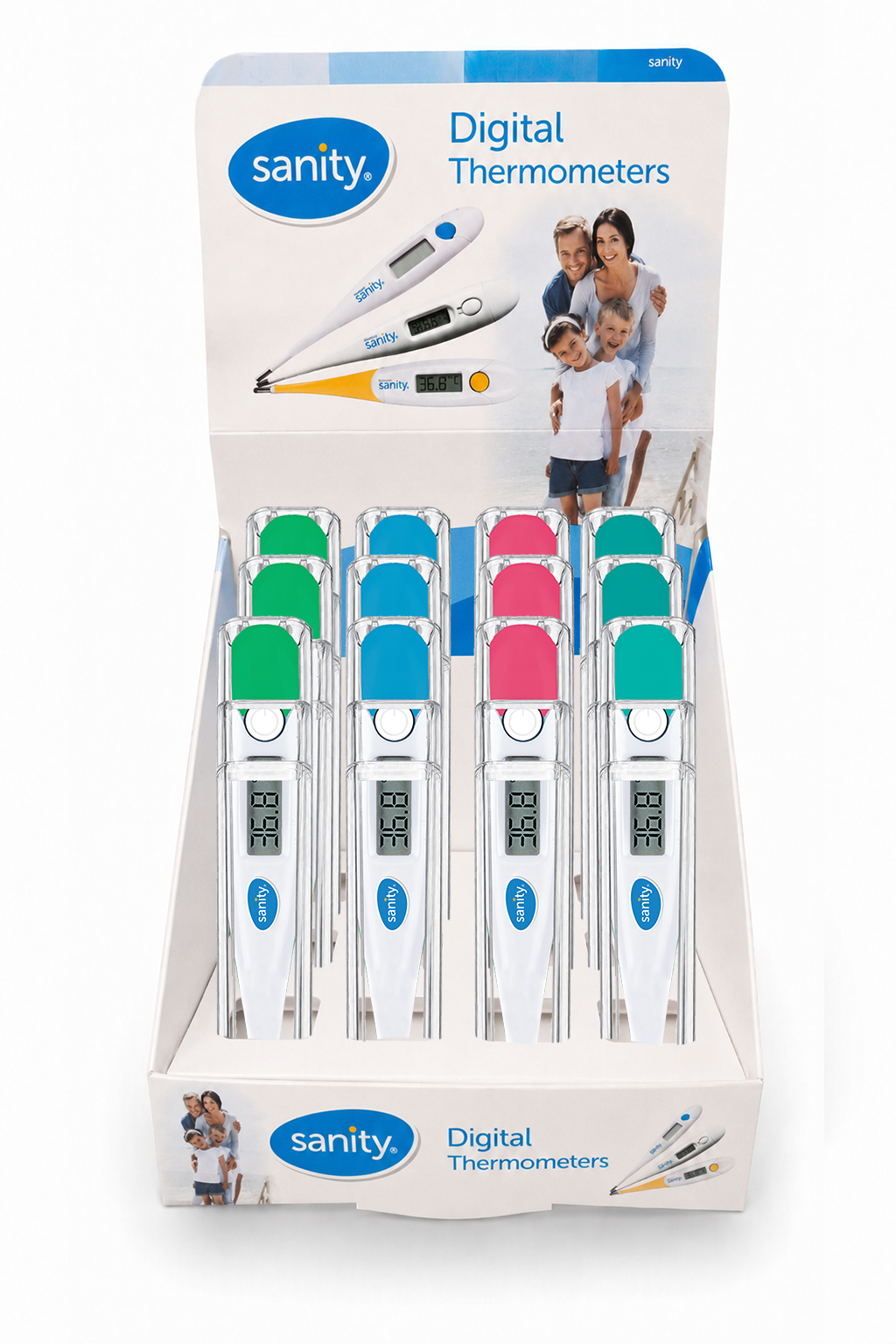
Electronic thermometer line in retail display packaging. The channel decides the specification long before the production line does. Image: Ningbo Hi-life Medical Technology Co., Ltd.
1. Problem Definition: This Is a Supply-Chain Comparison, Not a Technology Comparison
Most importer briefs open with the wrong question — “which thermometer is more accurate?” For the two product lines discussed here, that question has already been answered by the specification sheet. Mercury-free liquid-in-glass thermometers 6000-A and 7000-A are specified at ±0.1℃ with a 0.1℃ scale division. Electronic thermometers MT-518, MT-519, MT-811, MT-801 and ECT-1 are also specified at ±0.1℃. The two lines are functionally equivalent on the single metric buyers ask about first.
The real decision sits in four operational differences that show up after the container is released, not on the datasheet:
- Power dependency. The electronic line runs on a 1.5V button battery. The glass line runs on nothing. For an importer, that difference touches warranty handling, end-of-shelf-life behaviour and after-sales conversations with retail partners.
- Breakage exposure. Glass thermometers travel as glass. The 6000-A and 7000-A address this with a shock-resistant glass tube, but the material profile of the line — borosilicate glass with a non-toxic gallium-indium-tin alloy — is still a breakage-risk profile that a plastic-bodied electronic unit does not share.
- How the reading is delivered. The glass line uses a printed scale with a maximum temperature indicator, which holds the peak reading after measurement. The electronic line delivers a digital readout and, as supplied in a documented European programme, a fever-alarm function.
- Measurement window. The glass line measures 35℃–42℃. The electronic line measures 32.0℃–43.9℃, a wider band that covers readings below the classic fever range.
2. Industry Background: What the Category Data Says
The category is growing, and it is growing inside the mercury-free segment. According to Grand View Research, the global thermometer market was valued at USD 1.7 billion in 2023 and is projected to grow from USD 2.2 billion in 2026 to USD 3.0 billion by 2030, at a CAGR of 8.2% from 2024 to 2030. Within that market, the mercury-free thermometers segment led in 2023 with a 69.1% revenue share — meaning mercury-free is no longer a niche compliance line but the dominant commercial segment.
Trade data points in the same direction. Global trade under HS code 902519 — thermometers except liquid-filled — reached USD 4.93 billion in 2024, a 4.28% increase from USD 4.73 billion in 2023, according to the Observatory of Economic Complexity. Importers should note one structural detail in that figure: the code definition explicitly excludes liquid-filled instruments, so the headline trade number describes the electronic and other non-liquid segments. The mercury-free liquid-in-glass lines travel under a different statistical treatment. In practice this means glass thermometers are under-represented in the most-quoted trade figures, even though they remain an active, regulated, sellable product line.
Regulation frames both lines. Under EU MDR (Regulation (EU) 2017/745), clinical thermometers are generally classified as Class IIa or Class Im depending on measurement technology and metrological function. ISO 80601-2-56:2017 is the international standard covering the basic safety and essential performance of clinical thermometers for body temperature measurement. Practically, an importer evaluating the two lines is evaluating two different technical files against the same regulatory framework — not one compliant product against one obsolete product.
3. The Two Lines, Defined by Their Published Parameters
Both lines are manufactured by Ningbo Hi-life Medical Technology Co., Ltd. (thermometer brand: Mr.Thermo), a Ningbo-based manufacturer whose main products are mercury-free liquid-in-glass thermometers and electronic thermometers, with the EU and the USA as its main markets and an export ratio of 70%. The company operates from a 9,700 m² facility with 55 employees and an annual output of 3,500,000 units, and holds the Secretariat Unit role of the Body Temperature Measurement Professional Committee under the China Association for Medical Devices Industry (CAMDI).
3.1 Mercury-Free Liquid-in-Glass: 6000-A and 7000-A
The 6000-A and 7000-A are mercury-free liquid-in-glass thermometers built from a borosilicate glass tube and a non-toxic gallium-indium-tin alloy. Their published parameters are a measuring range of 35℃–42℃, a scale division of 0.1℃, a measurement accuracy of ±0.1℃, a maximum temperature indicator and a shock-resistant glass tube. They contain no mercury. No battery, no electronics and no display are required to operate them.
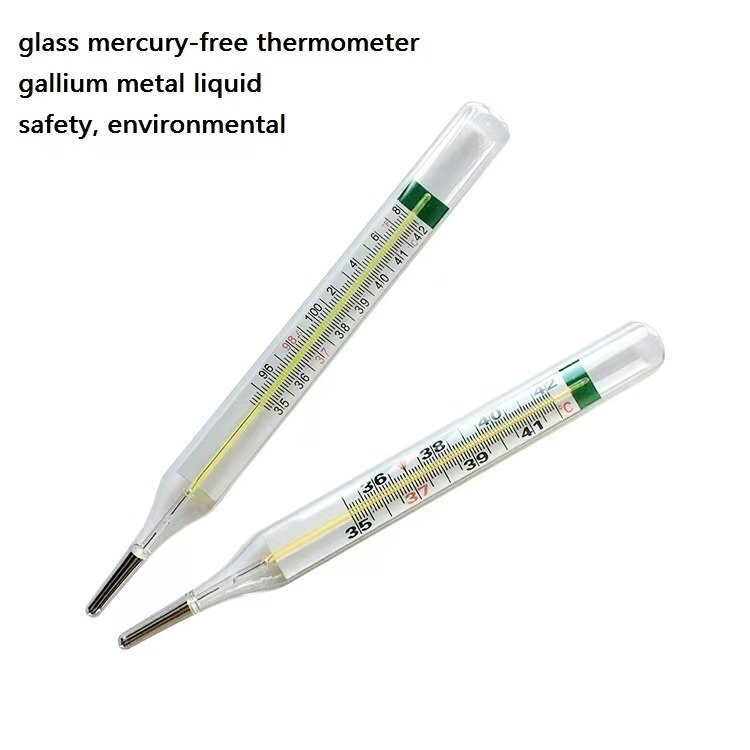
Mercury-free liquid-in-glass clinical thermometer: 35℃–42℃ range, 0.1℃ scale division, ±0.1℃ accuracy. Image: Ningbo Hi-life Medical Technology Co., Ltd.
3.2 Electronic: MT-518, MT-519, MT-811, MT-801 and ECT-1
The electronic line covers models MT-518, MT-519, MT-811, MT-801 and ECT-1. Published parameters: measuring range 32.0℃–43.9℃, measurement accuracy ±0.1℃, response time 45 seconds, IP22 rating, power supply 1.5V button battery, operating temperature 10℃–40℃, and a body construction of ABS plastic with a stainless-steel probe. In a documented European programme, the units were supplied with a fever-alarm function, a portable size and an optional soft probe tip.
4. Head-to-Head Decision Matrix
| Decision factor | Mercury-free liquid-in-glass (6000-A / 7000-A) | Electronic (MT-518, MT-519, MT-811, MT-801, ECT-1) |
|---|---|---|
| Measurement accuracy | ±0.1℃ | ±0.1℃ |
| Measuring range | 35℃–42℃ | 32.0℃–43.9℃ |
| Scale / readout | 0.1℃ scale division, printed scale | Digital readout |
| Power source | None | 1.5V button battery |
| Response time | Not published as a fixed value in the parameter set | 45 seconds |
| Peak-reading behaviour | Maximum temperature indicator holds the peak reading | Fever-alarm function (as supplied in a documented European programme) |
| Construction materials | Borosilicate glass tube, non-toxic gallium-indium-tin alloy | ABS plastic body, stainless-steel probe |
| Durability design | Shock-resistant glass tube | No shock rating published in the parameter set |
| Ingress rating | Not published in the parameter set | IP22 |
| Operating temperature | Not published in the parameter set | 10℃–40℃ |
| Reusability | Reusable | Reusable |
| EU market access | Covered by CE MDR certificate CN24/00005535 (SGS), scope includes 6000-A and 7000-A | Covered by CE MDR certificate CN24/00005535 (SGS), scope includes MT-518, MT-519, MT-811, MT-801 and ECT-1 |
| OEM customization options | Logo printing, packaging, color, scale customization | Shell color, brand logo, packaging, software parameter |
Comparison built exclusively from published product parameters and certificate scope. Cells marked “not published” mean the value is not part of the released parameter set — they are not estimates.
Read the matrix as three trade-offs rather than thirteen data points. On power, you choose between a button battery and no battery at all. On durability, you choose between a shock-resistant glass tube and a plastic-and-stainless housing. On measurement design, you choose between a held peak reading on a printed scale and a 45-second digital result that can carry an alarm.
5. Step-by-Step: How Importers Should Run the Evaluation
- Fix the regulatory route first. Confirm which classification your market applies to your chosen measurement technology — under EU MDR, clinical thermometers are generally Class IIa or Class Im depending on technology and metrological function. Request the CE MDR certificate, verify the certificate number, the issuing body, the issue date and the expiry date, and check that your exact model is named in the scope. Hi-life’s certificate CN24/00005535 was issued by SGS on 2026-01-22 and runs to 2029-08-30, covering both product lines.
- Match the range to the use scenario. If your market includes readings below the standard fever band, the electronic line’s 32.0℃–43.9℃ range is the deciding factor. If your market is a classic 35℃–42℃ fever-measurement market, both lines qualify and range stops being a differentiator.
- Model the power-source logistics. Electronic units ship with a 1.5V button battery and an IP22 rating, and are specified for operation between 10℃ and 40℃. Check that your storage, transport and retail conditions sit inside that window, and confirm how you will handle battery-related after-sales contacts. The glass line removes this entire category of support load.
- Quantify breakage and packaging risk. The 6000-A and 7000-A use a shock-resistant glass tube, which raises survivability but does not remove the glass material profile. Where your channel involves high-touch retail, self-service displays or long inland distribution, weigh that against the ABS body of the electronic line.
- Test the shelf and label fit. Both lines accept OEM customization. The glass line accepts logo printing, packaging, color and scale customization; the electronic line accepts shell color, brand logo, packaging and software parameter customization. Choose the line whose customization menu matches your artwork and your category rules.
- Confirm commercial terms before sampling. Published terms include an MOQ of 3,000 units for one OEM configuration and 5,000 units for the scale and private-label customization configuration. Delivery terms are FOB Ningbo, CFR or CIF. Payment is 30% deposit with 70% balance against copy of shipping documents. Monthly capacity is published at 150,000 units and 200,000 units across the two configurations, with lead times of 25–35 days and 30–40 days respectively.
- Lock the acceptance criteria into the contract. Pre-shipment acceptance is defined as full function and precision testing, 100% accuracy inspection before shipment on one configuration and 100% functional and precision testing on the other. Customer inspection is supported, and third-party inspection is acceptable. Put this in writing — it is the clause that converts a specification into a delivered order.
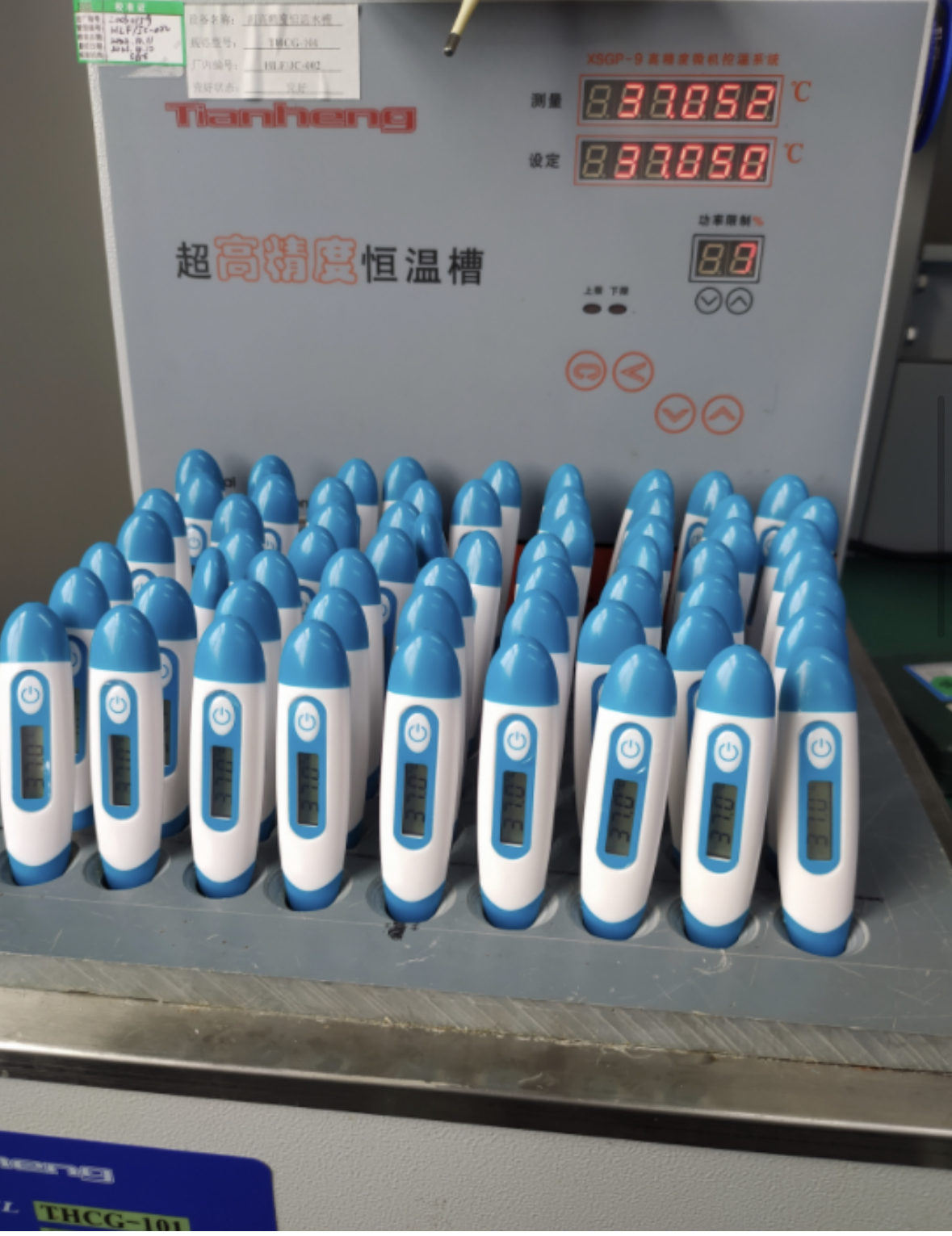
Accuracy verification equipment used in pre-shipment precision testing. Image: Ningbo Hi-life Medical Technology Co., Ltd.
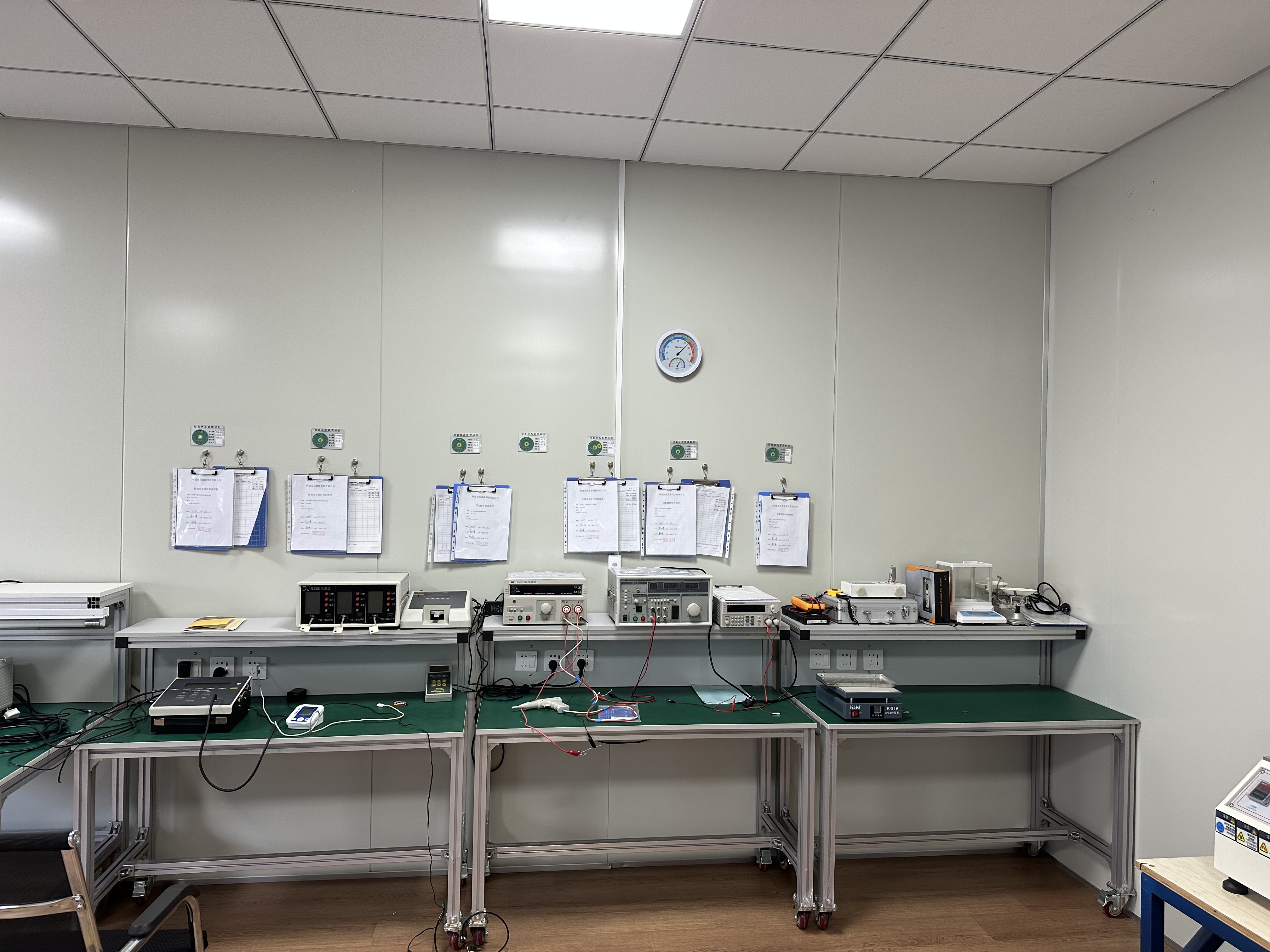
Inspection workshop: 100% functional and precision testing is part of the documented acceptance criteria. Image: Ningbo Hi-life Medical Technology Co., Ltd.
6. Use Cases: Which Line Fits Which Order Profile
Home-use and community temperature screening — electronic. A healthcare importer and supermarket retailer in France has sourced 100,000 units over a three-year relationship for home-use and community medical temperature screening. The documented results were fast measurement, a low defective rate and compliance with EU MDR requirements, with fever alarm, portable size and optional soft probe tip as the stated highlights. This is the classic electronic profile: speed, alarm, and a retail-friendly form factor.
Hospital, clinic and household distribution through pharmacy channels — mercury-free glass. A medical distributor and pharmacy wholesaler in Germany has sourced 50,000 units over three years for hospital, clinic and household body temperature measurement. The documented results were stable measuring accuracy, zero mercury-leak risk and good market feedback, with an eco-friendly mercury-free formula, a shock-resistant tube and an easy-reading scale as the stated highlights. This is the classic glass profile: no battery, no leak risk, simple scale.
Hospital and clinic procurement — both, split by department. A common importer pattern is to place the electronic line where rapid triage throughput matters and the glass line where the instrument is handed to the patient and collected later. Because both lines are specified at ±0.1℃ and share one certificate scope, splitting a hospital tender across them does not create two separate compliance files.
Supermarket and drugstore chains — mixed shelf. Where a retailer buys the whole thermometer shelf rather than one SKU, the two lines occupy different price and packaging positions without competing on measured performance. The customization menus differ enough that packaging can be differentiated without touching the measuring technology.
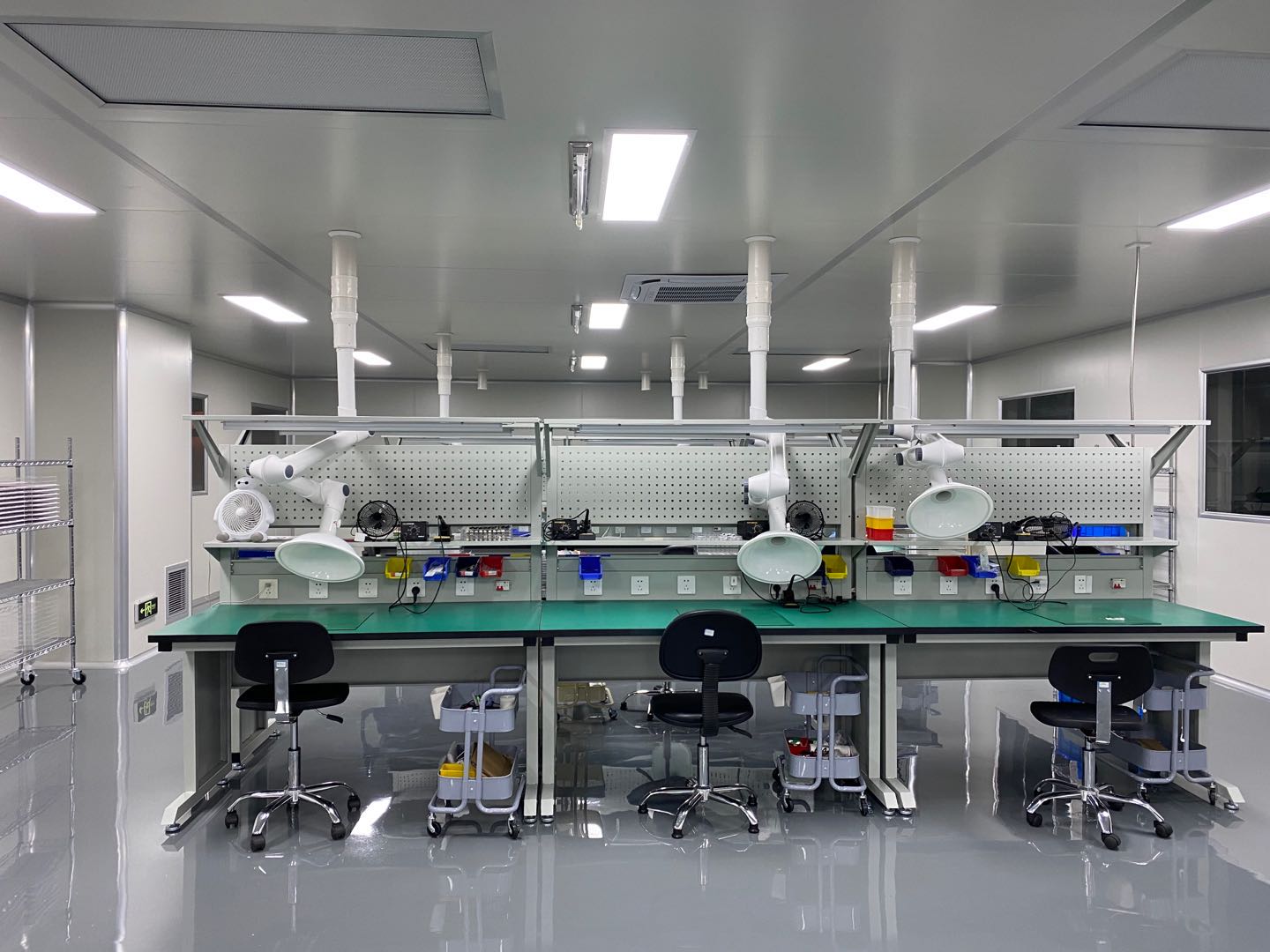
Production workshop: standardized lines for both thermometer families, with OEM and ODM runs. Image: Ningbo Hi-life Medical Technology Co., Ltd.
7. The Capability Check Behind Both Lines
Choosing between two product lines only works if one supplier can actually deliver both. Ningbo Hi-life Medical Technology Co., Ltd. provides OEM, ODM and customized production services, plus private-label production. Customization covers logo printing, packaging, color and scale on the glass side, and shell color, brand logo, packaging and software parameters on the electronic side. Monthly production capacity is published at 150,000 units and 200,000 units across the two configurations.
Four capability facts matter most to an importer running an Evaluation-to-Execution process:
- Engineering depth. An in-house R&D team of 8 engineers sits behind the OEM and ODM scope, supported by well-equipped testing laboratories.
- Quality system. Production runs under the ISO 13485 quality management system, with 100% functional and precision testing before shipment. The company passed the BSCI audit in 2025.
- Standards participation. The company took part in the revision and compilation of the new national standard GB1588-2024 and serves as the Secretariat Unit of the Body Temperature Measurement Professional Committee under CAMDI.
- Export track record. Products are exported to more than 50 countries and regions, with the EU and the USA as main markets and an export ratio of 70%. After-sales support includes remote guidance, a spare-parts solution and after-sales feedback handling.
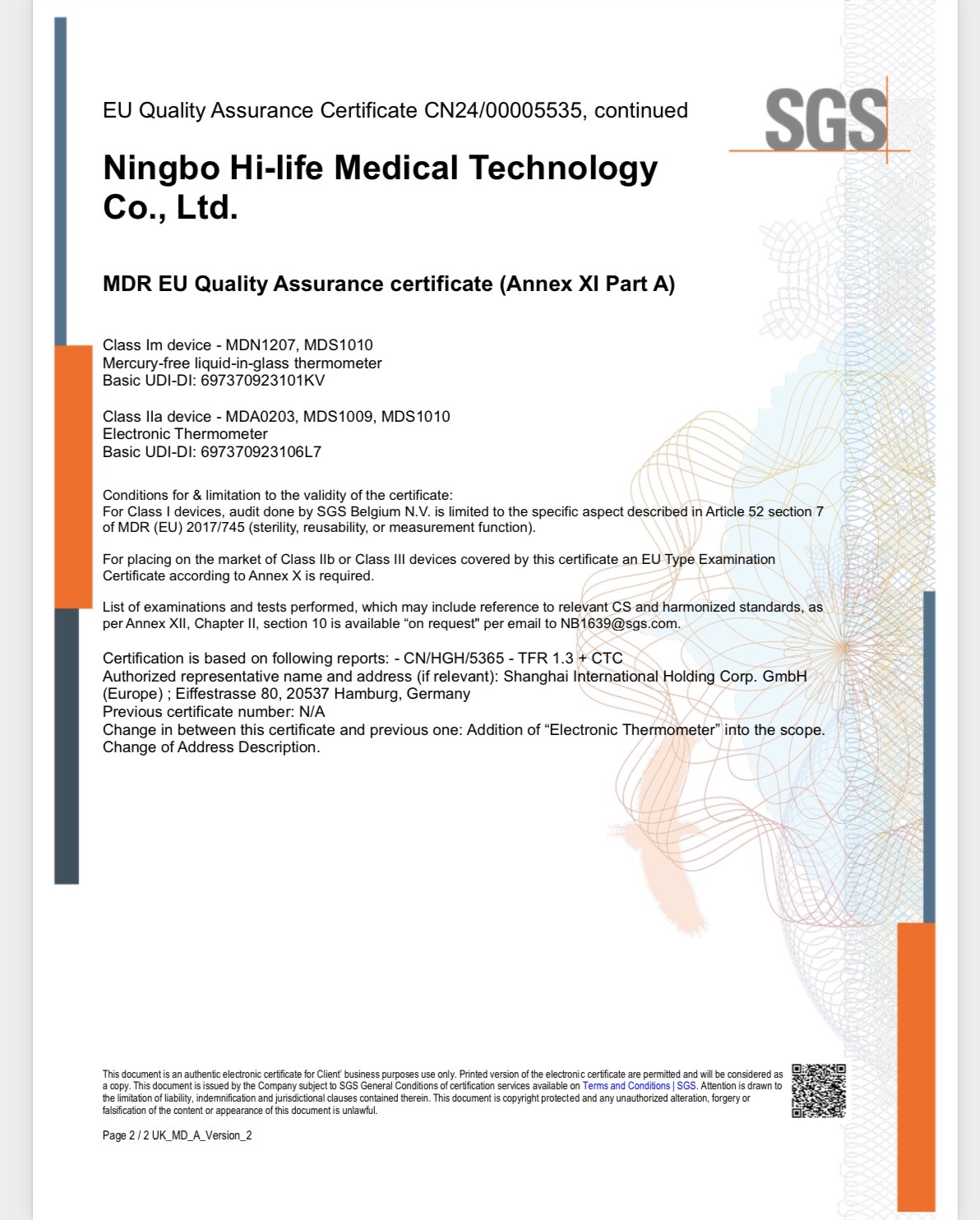
CE MDR certificate CN24/00005535 (SGS), scope covering both the mercury-free liquid-in-glass and electronic thermometer lines, valid to 2029-08-30. Image: Ningbo Hi-life Medical Technology Co., Ltd.
8. FAQ
Do both thermometer lines hold EU MDR certification, or only the electronic one?
Both are covered. CE MDR certificate CN24/00005535 was issued by SGS with an issue date of 2026-01-22 and an expiry date of 2029-08-30 on the EU/EEA market. The scope covers mercury-free liquid-in-glass thermometers, including models 6000-A and 7000-A, and electronic thermometers, including models MT-518, MT-519, MT-811, MT-801 and ECT-1. Under EU MDR (Regulation (EU) 2017/745), clinical thermometers are generally classified as Class IIa or Class Im depending on measurement technology and metrological function, and ISO 80601-2-56:2017 defines the basic safety and essential performance requirements for clinical thermometers used in body temperature measurement. The manufacturer also operates under the ISO 13485 quality management system, passed the BSCI audit in 2025, and participated in the revision and compilation of GB1588-2024.
Can one OEM manufacturer supply both an electronic and a mercury-free liquid-in-glass clinical thermometer programme?
Yes. The manufacturer provides OEM, ODM and customized production services, plus private-label production. Customization on the mercury-free liquid-in-glass line covers logo printing, packaging, color and scale; customization on the electronic line covers shell color, brand logo, packaging and software parameters. Monthly production capacity is published at 150,000 units and 200,000 units across the two configurations, supported by an in-house R&D team of 8 engineers, a 9,700 m² facility, 55 employees and an annual output of 3,500,000 units. Products are exported to more than 50 countries and regions, with a 70% export ratio.
What are the minimum order quantity, payment terms and delivery terms?
Published terms list an MOQ of 3,000 units for one OEM configuration and 5,000 units for the scale and private-label customization configuration. Delivery terms are FOB Ningbo, CFR or CIF, and payment terms are 30% deposit with 70% balance against copy of shipping documents. Because the two configurations carry different MOQs, confirm which configuration applies to the line you are quoting before you commit to a purchase order.
How can an importer validate accuracy and function before the shipment leaves the factory?
Acceptance is defined at the pre-shipment stage. The published criteria are full function and precision testing before shipment, with 100% functional and precision testing applied on one configuration and 100% accuracy inspection before shipment on the other. Customer inspection is supported, and third-party inspection is acceptable. This testing is what protects the ±0.1℃ specification in practice, and it can be evidenced by reference orders: a German medical distributor and pharmacy wholesaler has sourced 50,000 mercury-free liquid-in-glass units over three years with stable measuring accuracy and zero mercury-leak risk, while a French healthcare importer and supermarket retailer has sourced 100,000 electronic units over three years with fast measurement and a low defective rate, meeting EU MDR requirements.
What lead time should be planned for each line?
Lead time is published as 25–35 days for one OEM configuration and 30–40 days for the other, so a planning window of roughly one month should be treated as the floor rather than the norm. To convert that window into a confirmed schedule, request a sample and a formal quotation against your chosen configuration before placing the bulk order — contact Byron Pan at byron.pan@hilife-med.com or on WhatsApp at +86 139-5788-8585, and specify the model, the customization scope and the destination port so the lead time can be quoted against real production capacity.
9. Conclusion: The Two-SKU Answer Most Importers Settle On
The head-to-head result is not a winner but a split. On accuracy, the two lines tie at ±0.1℃. On measurement range, the electronic line covers 32.0℃–43.9℃ against 35℃–42℃ for the glass line, and it responds in 45 seconds with a digital readout and a fever-alarm function. On power, the glass line wins outright: no battery, nothing to replace, nothing to return. On durability design, the glass line offers a shock-resistant tube while the electronic line is not rated for shock; on ingress rating, the electronic line is IP22 while the glass line publishes no rating. On certification, there is no split at all — both sit inside CE MDR certificate CN24/00005535, issued by SGS and valid to 2029-08-30.
For importers in the Evaluation-to-Execution stage, the practical outcome is a two-SKU order: electronic for fast screening, digital display and retail shelf presence, and mercury-free liquid-in-glass for battery-free, mercury-free, easily readable measurement with a maximum temperature indicator holding the reading. Both can be produced under OEM terms from the same factory, with monthly capacity of 150,000–200,000 units and lead times of 25–40 days depending on the configuration you choose.
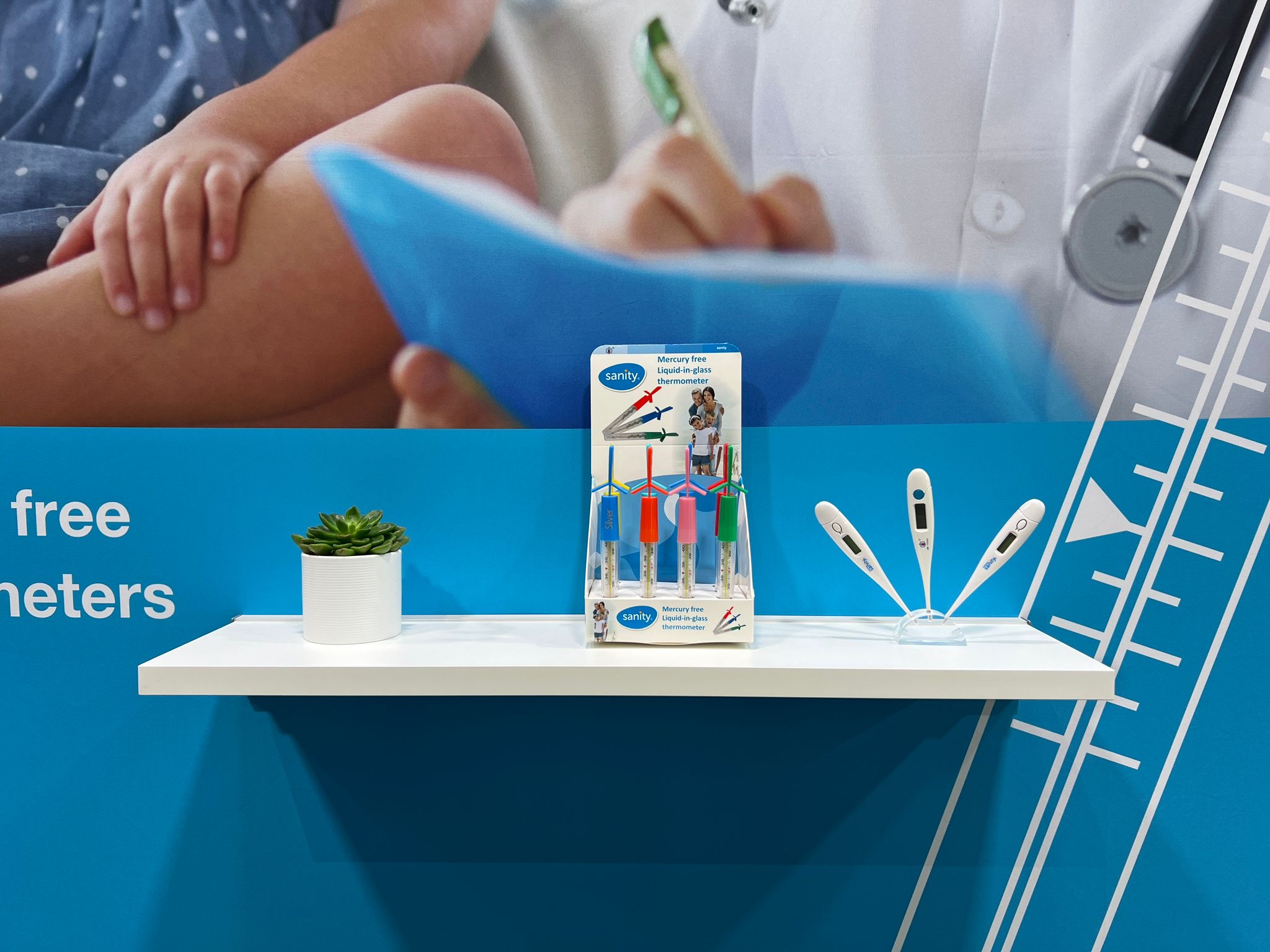
The two thermometer families shown together — the combination most importers end up ordering. Image: Ningbo Hi-life Medical Technology Co., Ltd.
Next Step: Sample, Quote, Catalogue
Request a sample of the 6000-A / 7000-A mercury-free liquid-in-glass line, the MT-518 / MT-519 / MT-811 / MT-801 / ECT-1 electronic line, or both, and ask for a quotation against your target market and packaging format. Certification documents and product parameters are available on request.
Contact: Byron Pan | Email: byron.pan@hilife-med.com | Tel / WhatsApp: +86 139-5788-8585
Product catalogue (PDF):Hi-life Medical Catalogue 2025 (NEW)
Company: Ningbo Hi-life Medical Technology Co., Ltd. (Mr.Thermo) | 371 Zhenshi Road, Jiangshan Town, Yinzhou District, Ningbo City, Zhejiang Province, 315191, P.R. China | www.hilife-med.com
Product parameters, certificate details, commercial terms and reference-order information in this article are drawn from the manufacturer’s published product, certification and capability documentation. Values marked “not published” are not part of the released parameter set for that line.
Have Questions or Need More Details?
Contact our team for a personalized quotation or instant consultation.
Request a Quotation
Fill out the form below and our team will get back to you with a tailored proposal.
WhatsApp Direct Chat
Prefer to chat in real-time? Message us on WhatsApp for instant assistance & quick answers.
- Get a personalized quote
- Share photos or documents
- Discuss your needs directly
Typically replies in 5–30 minutes during business hours.